In this article7 sections
The BRRRR method is a real estate strategy where you buy a property that needs work, rehab it, rent it to a tenant, refinance at the new higher value to pull most of your cash back out, and repeat the cycle on the next property. It is buy-and-hold with a renovation business bolted on. The math is powerful when it works and hard to execute on a first deal, especially at today's rates. This guide walks through the BRRRR method honestly, with real numbers, a full-cycle capital table, and the three places it commonly fails.
This article is for first-time investors curious about BRRRR and trying to decide whether it belongs on their first deal. Real Estate Explained publishes this site and sells the 28-day course mentioned at the end of this article. We'll define each step, run the math on a realistic example, test it against the current mortgage rate, and cover what BRRRR-promoting content skips. Tax treatment and commercial BRRRR are out of scope.
Key Takeaways
- BRRRR = Buy (a distressed property), Rehab (add value), Rent (find a tenant), Refinance (pull out most of your capital), Repeat.
- Realistic timeline: 6-12 months per cycle, not the "90-day BRRRR" some content claims.
- Initial capital: $40,000-$80,000 (down payment, rehab, reserves), most of which you recover at the refinance.
- Rates matter: at the 6.71% average 30-year rate (FRED, week ending 2026-09-03), the refinance payment in our example uses up almost all of the rental's net income.
- Three places BRRRR commonly fails: rehab budget overruns, a short refinance appraisal, and time underestimates.
- Skip BRRRR for your first deal unless you have construction background. Do 1-2 buy-and-holds first.
What does BRRRR stand for?
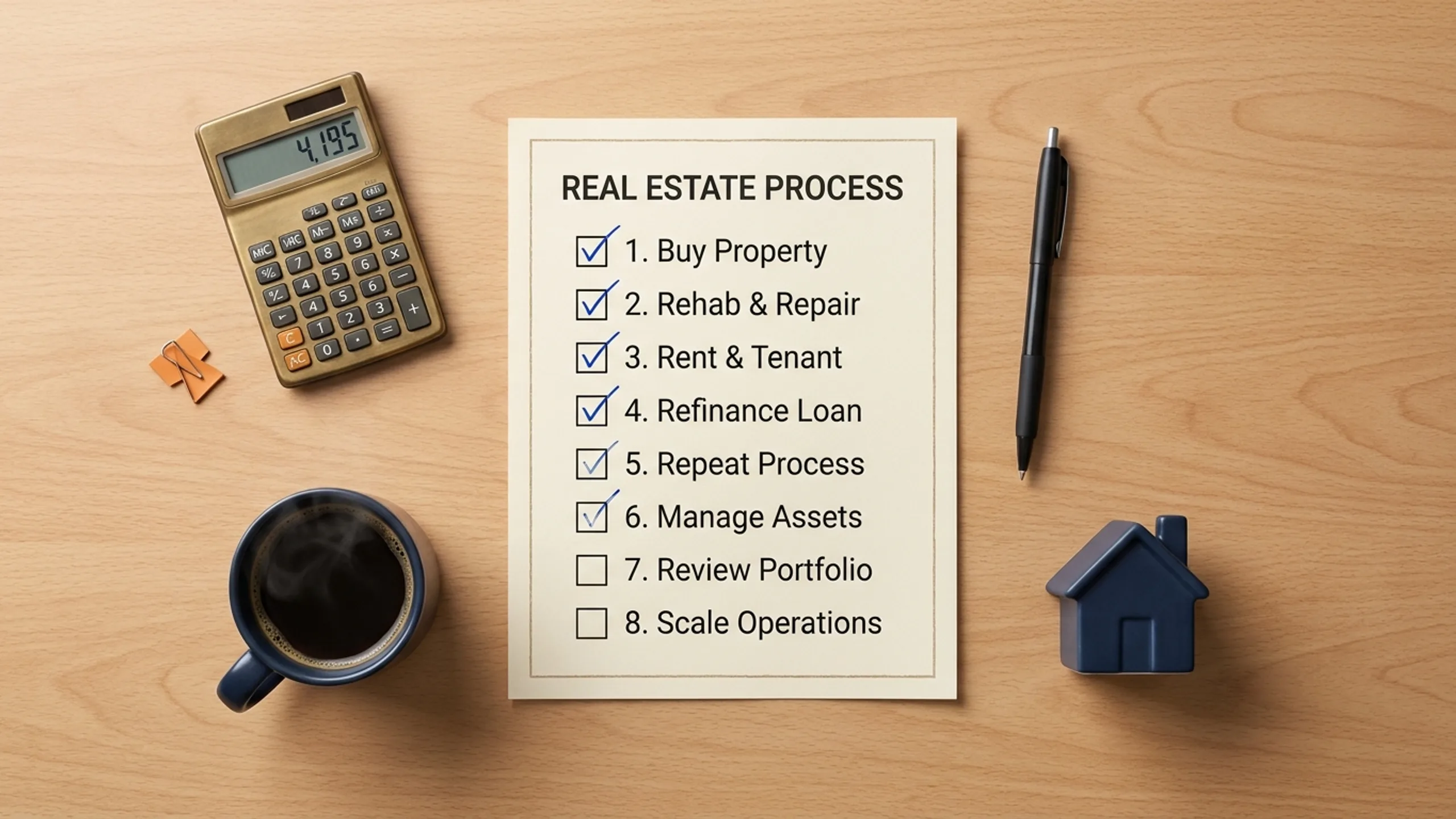
BRRRR became popular in U.S. real estate investor culture during the low-rate years of 2020-2022, when a cheap refinance made the fourth step easy. Each letter is one step in a five-step cycle, and Chase's BRRRR explainer describes the same sequence from the lender's side:
- Buy: purchase a property below market value, usually because it needs renovation.
- Rehab: renovate the property to increase its value and rent potential.
- Rent: place a qualified tenant at market rent.
- Refinance: refinance the property at its new (higher) value, pulling most of your initial capital out.
- Repeat: use that recycled capital to do it again on another property.
The strategy was popularized by David Greene in his 2019 book Buy, Rehab, Rent, Refinance, Repeat.
The acronym hides one thing: the Buy step is rarely financed with a normal 30-year mortgage, because conventional lenders generally want the house habitable first. Investors buy with cash, a hard money loan, a private loan, or a HELOC on a home they already own. That short-term money is expensive, so the clock matters. To see how much capital a specific deal returns, use the free BRRRR calculator. Many BRRRR refinances close on DSCR terms, so read how DSCR loans work before you count on one.
A worked example with real numbers
Step 1: Buy
You find a distressed single-family home in a stable Indianapolis neighborhood. The seller wants $130,000 cash because it needs work. You purchase it with a 20% down payment ($26,000) using a hard money loan or cash offer.
- Purchase price: $130,000
- Down payment: $26,000
- Closing costs: $4,000
- Total cash so far: $30,000
Step 2: Rehab
The property needs $25,000 of work: new kitchen, two bathrooms updated, paint throughout, flooring on the first floor, exterior cleanup. You complete the rehab in 3 months.
- Rehab budget: $25,000
- Reserve for overruns (15%): $3,750
- Total cash invested: $58,750
After rehab, the property's after-repair value (ARV) appraises at $200,000, and comparable rentals in the neighborhood show $1,650/month.
Step 3: Rent
You list the property and find a qualified tenant within 6 weeks at $1,650/month.
- Annual gross rent: $19,800
- Operating expenses (taxes, insurance, management, reserves): $7,500
- NOI (net operating income): $12,300
Step 4: Refinance
Two rules govern this step. First, seasoning. According to the Fannie Mae Selling Guide, section B2-1.3-03 (effective 2025-12-10), at least one borrower must have been on title for six months before a cash-out refinance disburses. The exception is delayed financing: if you bought with cash and no mortgage, you can refinance sooner, provided you document where the purchase funds came from. Second, loan-to-value. A typical investor cash-out refinance lends up to 75% of the appraised value, so the new $200,000 appraisal supports a $150,000 loan. That loan sits far below the 2026 conforming loan limit of $832,750 set by the FHFA, so it is ordinary conventional-lender territory, not a jumbo. The new loan pays off the $104,000 of purchase financing ($130,000 less your $26,000 down) plus any rehab loan, and returns the rest, roughly $46,000-$50,000 depending on the exact structure, as cash.
| Line item | Cash in | Cash back |
|---|---|---|
| Down payment | $26,000 | |
| Closing costs at purchase | $4,000 | |
| Rehab | $25,000 | |
| Overrun reserve (15%) | $3,750 | |
| Total invested | $58,750 | |
| Cash-out refinance at 75% of $200,000 | $46,000-$50,000 | |
| Net cash left in the deal | $9,000-$13,000 |
You also own a rental producing $12,300 of NOI a year, before the new mortgage payment, which the next section covers.
Step 5: Repeat
Take the $46,000-$50,000 you pulled out. Find another distressed property. Do it again.
This is the BRRRR appeal: a $200,000 rental with roughly $10,000 of your capital left in it, versus $40,000+ in a traditional buy-and-hold purchase.
Does BRRRR still work at 2026 interest rates?
According to Freddie Mac's Primary Mortgage Market Survey via FRED, the average 30-year fixed mortgage rate was 6.71% as of the week ending 2026-09-03. Run the refinance in our example at that rate and the picture changes. A $150,000 loan at 6.71% over 30 years costs about $969 a month in principal and interest, roughly $11,630 a year. Against $12,300 of NOI, that leaves about $670 a year of cash flow, a little over $50 a month. The debt service coverage ratio (NOI divided by the annual mortgage payment) is about 1.06, which is thin. The survey figure tracks conventional owner-occupied loans, and investor cash-out refinances usually price higher, so treat 6.71% as the floor in your own math.
According to FRED's 15-year series, the 15-year average was 6.04% the same week. A $150,000 loan at that rate costs about $1,269 a month, more than the property's entire NOI, which is why BRRRR refinances are almost always 30-year loans.
That is the real 2026 BRRRR problem: the refinance that frees your money also loads the property with a full-size loan at today's rate. Two ways to respond:
- Take less cash out. Refinancing at 65% instead of 75% ($130,000 loan, about $840 a month) leaves $20,000 more in the deal but gives you a rental that clears about $2,200 a year. Every $10,000 less borrowed saves about $65 a month at 6.71%.
- Underwrite the rental first. If the property does not cash flow at the post-refinance loan, it is a flip with extra steps. Run the post-refinance numbers with the rental cashflow calculator before you offer.
When this does not apply: if you refinance at a lower loan-to-value, buy in a market where rents are high relative to prices, or plan to pay the loan down, the coverage improves. Do not build a plan that needs rates to fall.
Where does BRRRR commonly fail?
The math above assumes everything goes right. Three places it commonly doesn't:
Failure mode 1: Rehab budget overruns
First-time renovators consistently underestimate rehab costs by 15-30%. What looks like a $25,000 rehab becomes $32,000 once you uncover plumbing issues, electrical updates, or unexpected structural problems.
In our example, a $7,000 budget overrun means another $7,000 of capital you can't recover at refinance. That's annoying but survivable.
A 30% overrun ($7,500 unanticipated) plus a permit-required structural repair ($15,000) takes the total cash invested from $58,750 to $81,250. The math compresses fast.
Mitigation: get 3 contractor bids (the lowest is usually the riskiest). Add 15-20% buffer to budgeted costs. For your first BRRRR, expect costs to come in 10-20% above estimate.
Failure mode 2: Refinance appraisal short
The whole BRRRR math depends on your post-rehab appraisal supporting the new loan. If your projected $200,000 ARV comes back as $175,000, your 75% LTV loan is now $131,250 instead of $150,000. That's $18,750 less capital recycled.
Properties don't always appraise where you expected. Local appraisers use conservative comps. Renovation quality matters but doesn't always translate proportionally to value.
Mitigation: get a pre-purchase appraisal estimate from a local appraiser before buying. Buy in markets where comparables are abundant. Don't over-renovate beyond the neighborhood ceiling.
Failure mode 3: Time underestimates
Online BRRRR content often claims 90-day cycles. Realistic first-time BRRRR is 6-12 months from offer to refinanced and rented. Every month adds carrying costs: interest on the short-term purchase and rehab money, taxes, insurance, utilities, and no rent coming in. The six-month seasoning clock also means the refinance cannot close before month seven at the earliest unless you bought with cash.
Mitigation: build the realistic timeline into your projections. Don't compare yourself to experienced BRRRR operators with crews on standby; they did 30 deals before they got that fast.
For the full underwriting method on any BRRRR property, see a rental property deal analysis walkthrough.
Should you BRRRR or just buy-and-hold?
Honest decision criteria, using the example above:
| BRRRR | Buy-and-hold | |
|---|---|---|
| Cash left in the deal | $9,000-$13,000, if the appraisal lands | The full down payment and closing costs, typically 20-25% of price plus 2-5% |
| Time to a stabilized rental | 6-12 months of active management | Typically 1-3 months |
| Skills you need | Contractor management, budgeting, reading appraisal comps | Tenant screening, basic maintenance |
| Biggest single risk | The refinance appraisal comes in short | Overpaying on the purchase |
| Cash flow after financing | Thinner, because the loan is sized to the new value at today's rate | Usually stronger per dollar borrowed |
| Does not apply when | You have no contractor network, a demanding day job, or a market with thin comps | You need to scale faster than savings allow |
For most first-time investors, do 1-2 traditional buy-and-hold deals first. Get comfortable with the operational side of being a landlord. Then attempt BRRRR with experience. See buy-and-hold real estate for beginners for the foundational strategy.
Plan the cash side before you pick. The First Deal Cash Planner estimates the down payment, closing costs, and reserves for a straight purchase, and how much cash reserves a rental needs covers the buffer BRRRR overruns eat first. The strategy finder asks about your cash, time, and risk tolerance and points you at the strategy that fits.
Common mistakes new BRRRR investors make
Choosing a property too distressed. Properties needing structural work, foundation repairs, or significant code-required updates are not ideal first BRRRRs. Stick to cosmetic-heavy rehabs (paint, flooring, kitchen, bathroom) for your first deal.
Underestimating contractor management. Even good contractors run late and over-budget. Plan for 20% time overruns and 15-20% budget overruns on your first BRRRR.
Choosing a market where comparable sales are sparse. BRRRR depends on the refinance appraisal. Markets with thin comps (rural areas, very small metros) make the appraisal step risky.
Forgetting to factor in the value of your time. Even if BRRRR works on paper, 200+ hours of project management for $50,000 of recycled capital might or might not be worth it depending on your hourly equivalent.
Not sure BRRRR is the right first move? The free strategy guide compares it against house hacking, buy and hold, and flipping so you can pick a starting point.
Frequently Asked Questions
What does BRRRR stand for?
Buy, Rehab, Rent, Refinance, Repeat. You buy an undervalued property, renovate it to add value, rent it to a qualified tenant, refinance at the new higher value to pull most of your capital out, and use that recycled capital on the next property. The refinance step is where the strategy succeeds or stalls.
How is BRRRR different from regular flipping?
Flipping ends with a sale. BRRRR ends with you keeping the property as a rental. Flipping captures the renovation profit as cash in 3-6 months. BRRRR keeps that equity in the property and adds long-term cashflow, but it ties up your money for 6-12 months while the rental stabilizes and the refinance closes.
What's a realistic BRRRR timeline?
Plan on 6-12 months from offer to refinanced and rented for a first-time investor. Buying takes 1-2 months, rehab 2-4 months, finding a tenant 1-2 months, and the refinance 1-2 months once the six-month seasoning clock has run. Nine months is a realistic planning figure. Treat 90-day claims as full-time-operator numbers.
How much capital do I need to start a BRRRR?
Budget $40,000-$80,000 up front: a down payment on the discounted purchase ($20,000-$40,000), a rehab budget ($15,000-$30,000), and reserves for surprises ($5,000-$10,000). You should get most of it back at the refinance, but you need all of it first. BRRRR is not a no-money-down strategy, whatever the videos say.
What if my refinance appraisal comes in low?
A low appraisal is the single biggest BRRRR risk. If the property appraises below your projected value, the refinance returns less capital and you have less to roll into the next deal. Get a conservative value opinion before you buy, budget a 10-15% cushion, and accept that a short refinance turns BRRRR into a slower buy-and-hold.
Should I do BRRRR for my first deal?
Probably not. BRRRR stacks renovation risk on top of the normal first-deal risks: financing, tenant management, and market knowledge. The better path is one or two buy-and-hold or house-hack deals first, then BRRRR once you have managed a contractor and a tenant. Most successful BRRRR investors started with plain buy-and-hold.
BRRRR is a powerful strategy when executed well by experienced operators. For first-time investors, the math looks better in a YouTube video than it does in real life. Start with buy-and-hold, learn the operational side, then add BRRRR to your toolkit on deal #2 or #3. The 28-day course walks through both strategies in week 4 with realistic timelines and budgets.
This article is education, not financial, legal, or tax advice. Real estate carries risk, and the numbers here are examples. Check them against your own market and talk to a licensed professional before you buy.