In this article8 sections
Cap rate sounds intimidating until you see it written out. The formula has three letters and one division sign. By the end of this article you'll be able to calculate cap rate on any property in under a minute, using a real $200,000 duplex example to walk through every step.
This article is for first-time investors who keep hearing "cap rate" thrown around in real estate podcasts and want to actually understand what it means. If math anxiety has kept you from running the numbers on properties, you're in the right place. We'll go slowly, define everything, and use real numbers throughout.
Key Takeaways
- Cap rate formula: Net Operating Income (NOI) divided by purchase price, expressed as a percentage.
- On our $200,000 duplex with $17,000 NOI, the cap rate is 8.5%.
- Good cap rate range for residential rentals: typically 6-10%, depending on market and strategy.
- Cap rate excludes the mortgage on purpose, because it measures the property's return as if you paid all cash. Your specific financing shows up in cash-on-cash return instead.
- The biggest cap rate blind spot: it ignores appreciation, leverage, and the cost of your time. Use it as a starting point, not a final answer.
The cap rate formula (one sentence)
Cap rate is the standard valuation ratio used in U.S. commercial and multifamily real estate per Fannie Mae multifamily lending guidelines and tracked in Federal Reserve commercial real estate research. If you would rather not do it by hand, the free rental cashflow calculator does the same math.
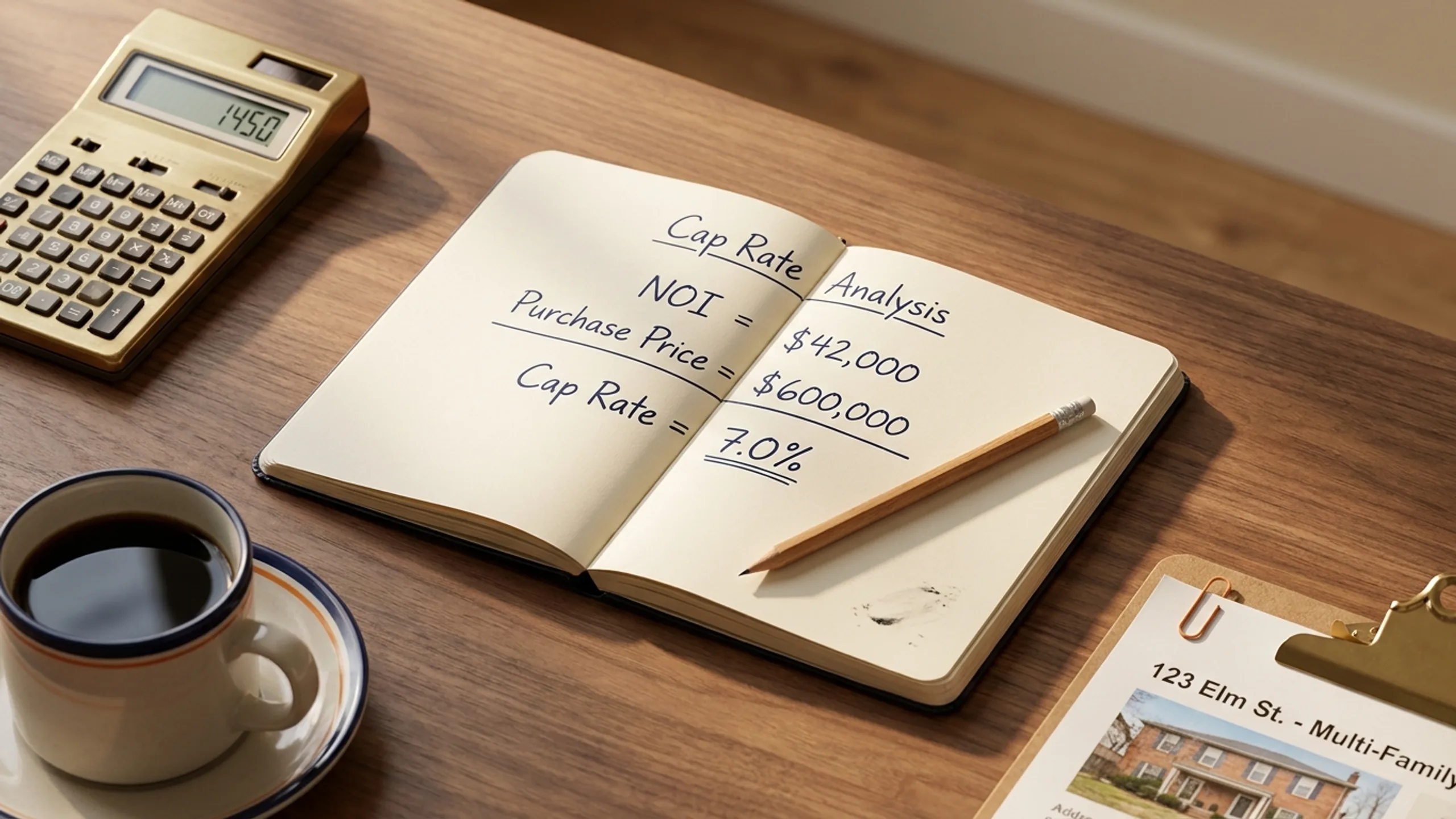
Cap rate equals Net Operating Income divided by purchase price, expressed as a percentage.
That's it. The whole formula:
Cap Rate = (NOI / Purchase Price) × 100
If you can divide two numbers and multiply by 100, you can calculate cap rate. The hard part isn't the math. The hard part is calculating NOI correctly, which we'll cover next.
Step 1: Calculate NOI (the top of the equation)
Net Operating Income is the property's annual income minus its operating expenses, before any mortgage payments. Per Investopedia's NOI definition, it represents what's left after the property covers its own running costs but before any debt service.
The NOI formula:
NOI = Annual Rental Income - Operating Expenses
What counts as operating expenses (include these):
- Property taxes
- Insurance
- Property management fees (typically 8-10% of rent)
- Repairs and maintenance
- Vacancy reserve (5-8% of gross rent)
- Capital expenditure reserve (5-10% of gross rent for big-ticket items like roofs)
- Utilities you pay (water, trash, sometimes lawn)
- HOA fees if applicable
What does NOT count as operating expenses (leave these out):
- Mortgage principal and interest
- Depreciation (it's an accounting expense, not a cash expense)
- Income taxes
- Capital improvements that add value (different from maintenance)
- Loan origination fees
The mortgage exclusion is the key insight. If you included the mortgage, your cap rate would change every time interest rates moved or you refinanced. The point of cap rate is to evaluate the property itself, not the financing structure you happened to put on top of it.
Step 2: Run the math on a real property
Let's use a $200,000 duplex in Indianapolis. Both sides rent for $1,100/month, so total annual rent is $26,400.
Annual income: $26,400 (gross)
Operating expenses (annual):
- Property tax (1.05% Indiana average): $2,100
- Insurance: $1,800
- Property management (8%): $2,112
- Repairs and maintenance (5% of rent): $1,320
- Vacancy reserve (6%): $1,584
- Capex reserve (5%): $1,320
- Lawn and snow service: $600
- Total operating expenses: $10,836
NOI: $26,400 - $10,836 = $15,564
That's the NOI. Now divide by purchase price:
Cap Rate = ($15,564 / $200,000) × 100 = 7.78%
So this duplex has a cap rate of about 7.8%. That's a solid number for a Midwest market.
If we'd ignored vacancy and capex reserves (a common beginner mistake), our "NOI" would have looked like $18,468, giving a cap rate of 9.2%. That's the difference between being honest about real ownership costs and just doing back-of-napkin math. Always include the reserves.
For a step-by-step framework on running these numbers on any property you're considering, see how to analyze a house hack before you buy.
What does cap rate actually mean?
Here's the analogy that makes it click: cap rate is like the speedometer of a property. It tells you how fast money is coming in, not what the property cost.
A 7.8% cap rate means: if you bought this property in cash and did nothing clever with it, you'd earn back 7.8% of the purchase price each year as operating profit, before the mortgage takes its cut.
Compare cap rates across two properties:
- Property A: $300,000 purchase, 6% cap rate → $18,000 NOI/year
- Property B: $250,000 purchase, 9% cap rate → $22,500 NOI/year
Property B costs less AND produces more income. That's worth understanding even before you decide which one to actually buy (the answer depends on appreciation potential, neighborhood quality, and a dozen other factors that cap rate alone can't see).
What is a "good" cap rate?
There's no single right number, but here's how to read the ranges:
| Cap rate | What it usually means |
|---|---|
| Below 4% | Coastal market, appreciation-focused. You're paying for future value, not current income. |
| 4-6% | Major U.S. metros (Austin, Nashville, Tampa). Decent but tight cashflow. |
| 6-8% | Solid mid-market range. Cleveland, Indianapolis, Kansas City typically land here. |
| 8-10% | Strong cashflow markets (Memphis, Birmingham, parts of Pittsburgh). |
| Above 10% | High-yield but usually higher risk: older properties, declining neighborhoods, or harder management. |
For most first-time investors targeting cashflow, 7-9% is the sweet spot. High enough to actually produce income after the mortgage. Low enough that you're not buying into structurally declining areas just to chase yield. For specific cities in this range, see best cities for first-time real estate investors in 2026.
Cap rate's blind spots
Cap rate is a useful starting metric. It's not the whole picture. Three things it ignores:
1. Leverage (your mortgage). A property with a 7% cap rate can produce a 15% return on your actual cash invested if you finance it well, or a 4% return if you finance it badly. Cap rate doesn't see any of that. For the leverage view, use cap rate vs cash-on-cash return.
2. Appreciation. A 5% cap rate property in a market growing at 6% per year often beats an 8% cap rate property in a flat market over a 10-year hold. Cap rate is a one-year snapshot of operating income. It says nothing about the property's future value.
3. Time and management cost. Two properties can have identical cap rates but completely different management headaches. A clean Class A property at 6% cap rate and a Class C property with constant tenant turnover at 6% cap rate are not the same investment, even though they look identical on the spreadsheet.
Cap rate for commercial vs residential
Commercial real estate (office, industrial, retail, multifamily 5+ units) almost always reports cap rates. It's the primary valuation metric.
Residential rentals (single-family, duplexes, triplexes, fourplexes) often skip cap rate in favor of cash-on-cash or simple cashflow numbers. That's because most residential investors finance with high leverage, which makes cash-on-cash more representative of their actual experience.
Both metrics are valid for both property types. Use cap rate when you want to compare properties as if they were unfinanced. Use cash-on-cash when you want to know what your actual cash investment will produce.
The free PDF guide has a one-page worksheet that walks through both calculations side by side. If you would rather have software run these numbers, our DealCheck review covers where it helps and where it still leaves the judgement to you.
Frequently Asked Questions
What is a good cap rate for rental property?
For residential rentals in the U.S., a good cap rate is generally 6-10%. Below 6% usually means the property is in an appreciation-focused market (coastal cities) where you accept lower current income for higher long-term value. Above 10% often signals higher risk: older buildings, declining neighborhoods, or markets with weak rent growth. The "right" cap rate depends entirely on what you're optimizing for.
Does cap rate include the mortgage?
No. Cap rate uses Net Operating Income (NOI), which excludes mortgage payments entirely. This is intentional. The cap rate is meant to compare properties as if they were all bought with cash. Your specific financing decisions show up in cash-on-cash return, not cap rate.
What's the difference between cap rate and ROI?
Cap rate measures the property's annual return relative to its market value, ignoring financing. ROI usually includes appreciation and mortgage paydown over the entire holding period. Cap rate is a snapshot at one moment; ROI is the full-deal return measured over time. Both are useful for different decisions.
Should I use the purchase price or the current market value?
When you're buying, use the purchase price (it's the most concrete number). After you own the property, use the current market value to track how the property's yield is shifting. If your property has appreciated 30% but your rent only grew 10%, your cap rate based on current value has dropped, even though the property is more valuable.
Why do commercial properties usually have lower cap rates than residential?
Commercial cap rates often run 4-7% in major markets. Residential rentals run higher (6-10%). The reason: commercial properties typically have longer leases (5-10 years), creditworthy tenants, and more predictable cashflow, which makes them less risky and therefore more expensive per dollar of NOI. Lower risk equals lower yield.
Can cap rate be negative?
Yes, if operating expenses exceed gross income. A negative cap rate means the property is bleeding cash before any mortgage payment. This usually signals serious problems: catastrophic vacancy, major capex emergencies, or a fundamentally broken expense structure. Negative cap rate properties are rare but they exist, and they're a clear sell signal for the current owner.
Cap rate is the first metric you'll learn and the first one you'll outgrow. For an even faster first-pass screen, compare it against gross rent multiplier. Use it to filter properties quickly, then run cash-on-cash return on the survivors. The 28-day course walks through both calculations in week 4 with calculator templates included.
This article is education, not financial, legal, or tax advice. Real estate carries risk, and the numbers here are examples. Check them against your own market and talk to a licensed professional before you buy.