
In this article8 sections
Both cap rate and cash-on-cash return measure how well a rental property performs as an investment. They give different numbers for the same property. Here's the entire difference in one sentence: cap rate ignores your mortgage; cash-on-cash includes it. Once you understand that one distinction, the rest follows naturally.
This article is for first-time investors who've heard both terms and want to know which one to use. If you've also been wondering whether cap rate even applies to financed properties, the answer is yes, but you need both metrics to see the full picture. We'll walk through both with the same $200,000 duplex example so you can see exactly what changes.
Key Takeaways
- Cap rate measures return on the property as if you bought it cash. Formula: NOI ÷ purchase price.
- Cash-on-cash return measures return on the cash you actually invested. Formula: annual cashflow after mortgage ÷ total cash invested.
- On the same $200,000 duplex with 20% down: cap rate is 7.8%, cash-on-cash is 13.4%.
- The gap between them is leverage. A mortgage amplifies returns (when it works) and amplifies losses (when it doesn't).
- Use cap rate to compare properties or markets. Use cash-on-cash to evaluate your specific deal with your specific financing.
Quick comparison
| Feature | Cap rate | Cash-on-cash return |
|---|---|---|
| What it measures | Property's unleveraged yield | Return on your actual cash investment |
| Formula | NOI ÷ Purchase Price | Annual Cashflow ÷ Total Cash Invested |
| Includes mortgage? | No | Yes (mortgage payments reduce cashflow) |
| Affected by your down payment? | No | Yes |
| Best for | Comparing properties or markets | Evaluating your specific deal |
| Typical range | 6-10% (residential) | 8-15% (with mortgage financing) |
What is cap rate (briefly)
Cap rate is the standard income-property valuation ratio used in U.S. commercial real estate per Fannie Mae multifamily lending guidelines and tracked in Federal Reserve commercial real estate research.
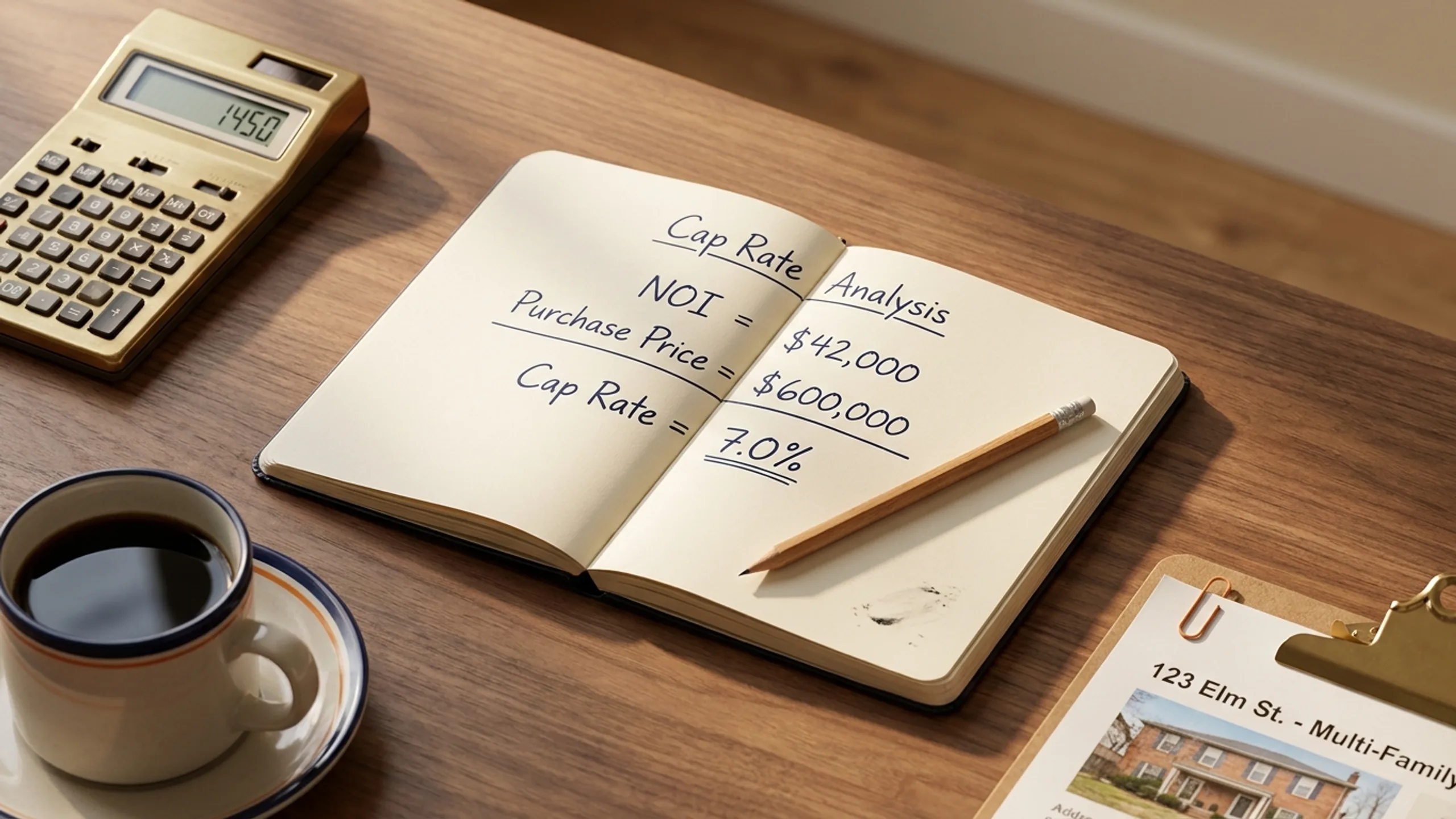
Cap rate (capitalization rate) is the property's annual NOI divided by its purchase price, expressed as a percentage. It assumes you paid cash. For the full walkthrough with worked examples, see how to calculate cap rate.
The key thing for this comparison: cap rate strips out financing. A property has the same cap rate whether you pay cash, finance it 20% down, or finance it 50% down. The property doesn't care how you bought it.
What is cash-on-cash return
Cash-on-cash return measures the annual cashflow you actually receive divided by the cash you actually invested. Per Investopedia's cash-on-cash definition, it's a "before-tax" measure that focuses on the cash you put in and the cash you get out. The free rental cashflow calculator works both figures out for you.
The formula:
Cash-on-Cash Return = (Annual Cashflow / Total Cash Invested) × 100
Where:
- Annual cashflow = NOI minus mortgage principal and interest
- Total cash invested = down payment + closing costs + initial repairs
Cash-on-cash answers a different question than cap rate: "If I put $X of my own money into this deal, what return am I getting on that specific dollar amount?"
Worked example: same property, both metrics
Let's use the same $200,000 duplex from the cap rate article. Both sides rent for $1,100/month ($26,400/year). Operating expenses (taxes, insurance, management, reserves) total $10,836/year. NOI is $15,564.
Cap rate (no mortgage)
Cap Rate = ($15,564 / $200,000) × 100 = 7.78%
If you bought this property in cash, you'd earn 7.78% per year on the property's value.
Cash-on-cash return (with 20% down financing)
Let's say you put 20% down ($40,000) plus $5,000 closing costs and $3,000 initial repairs. Total cash invested: $48,000. The mortgage covers the remaining $160,000 at 6.5% interest, 30-year term, which is roughly $1,011/month ($12,132/year) in principal and interest payments.
Annual cashflow = NOI - mortgage P&I = $15,564 - $12,132 = $3,432
Cash-on-Cash Return = ($3,432 / $48,000) × 100 = 7.15%
Hmm, that's actually slightly LOWER than the cap rate. With current high rates and modest yields, leverage is working against you on this specific deal.
What if rates were lower?
Same deal, but assume a 5% interest rate instead of 6.5%. Mortgage P&I drops to about $859/month ($10,308/year).
Annual cashflow = $15,564 - $10,308 = $5,256
Cash-on-Cash Return = ($5,256 / $48,000) × 100 = 10.95%
Now leverage is working. Cash-on-cash is meaningfully higher than cap rate. You're earning a return on the entire $200,000 property while only putting $48,000 of your own cash in.
This is the entire point of leverage. When the property's NOI exceeds the mortgage cost, financing amplifies your return. When the mortgage cost exceeds the NOI, financing kills your return. Whether leverage is your friend depends entirely on the spread between your cap rate and your interest rate. To watch both metrics come out of a complete underwrite, see a worked deal analysis example that stress-tests the same kind of property.
The leverage analogy
Here's the way to remember the difference: cap rate is the property's speedometer. Cash-on-cash is your gas mileage.
The speedometer tells you how fast the property itself produces income, regardless of how you bought it. The gas mileage tells you how efficiently your specific dollars are converting into cashflow, given the financing terms you got. Both matter. They measure different things.
A property with a 7% cap rate can produce a 15% cash-on-cash return at 4% interest, an 8% cash-on-cash at 6% interest, or a negative cash-on-cash at 9% interest. The property hasn't changed. The financing has.
When to use each
Use cap rate when:
- Comparing two properties side by side (financing variation gets in the way)
- Comparing markets (Cleveland vs Phoenix, etc.)
- Evaluating a property as if you'd pay cash (relevant for retirees or investors with cash reserves)
- Talking to commercial brokers (they speak in cap rates)
- Looking at long-term yield trends (markets shift cap rates over years)
Use cash-on-cash when:
- You're financing the purchase (most first-time investors)
- You want to know what return your actual money is earning
- Comparing real estate to other investments where you'd put a similar dollar amount (stocks, index funds)
- Evaluating whether to put more or less down (the down-payment lever changes cash-on-cash significantly)
For step-by-step deal analysis using both metrics, see how to analyze a house hack before you buy.
A common beginner mistake
Reaching for whichever metric makes the deal look better. You'll find guides that emphasize cap rate when interest rates are high (because cap rate ignores them) and guides that emphasize cash-on-cash when rates are low (because leverage shines). Don't pick a metric to support a conclusion. Calculate both, look at both, and accept what they tell you.
A deal with a great cap rate and bad cash-on-cash is telling you the financing terms are working against you. Either accept lower returns, put more cash down (which often improves cash-on-cash by reducing interest paid), or wait for better rates. A deal with a bad cap rate and great cash-on-cash usually means you got lucky with cheap financing on a mediocre property; if you ever refinance into a higher rate, the deal stops working.
For more on calculating these reserves correctly so your numbers don't lie to you, see how to calculate NOI for a rental property.
Frequently Asked Questions
Are cap rate and cash-on-cash return ever the same number?
Yes. When you buy a property in all cash with no mortgage, your cap rate equals your cash-on-cash return. The leverage difference is what makes them diverge. As soon as you finance with a mortgage, the two numbers split, and the more leverage you use, the bigger the gap.
Which one matters more for residential investors?
For most first-time residential investors using mortgage financing, cash-on-cash return matters more day-to-day. It tells you what your actual money is producing. But cap rate matters when you're comparing properties or shopping in different markets, because it strips out the financing variable and compares apples to apples.
Why is cash-on-cash usually higher than cap rate when you finance?
Because you're using leverage. You're earning a return on the entire property's value but only investing a fraction (your down payment + closing costs) of that value. The mortgage covers the rest. So your return is calculated against a smaller denominator, making the percentage larger. This is the magic of leverage, when it works.
Can cash-on-cash return be lower than cap rate?
Yes, in two scenarios. First, if your interest rate is so high that the mortgage payment exceeds the property's NOI, you'll have negative cashflow and negative cash-on-cash. Second, if you put down a very large down payment (e.g., 50%+), the leverage benefit shrinks and the two numbers converge or even invert. Both signal that the financing structure isn't working.
What's a good cash-on-cash return target?
Most experienced investors target 8-12% cash-on-cash for stabilized residential rentals. Below 6% means the leverage isn't earning you much; you might do better in index funds. Above 15% usually means high risk (very old properties, declining areas) or aggressive leverage that exposes you to interest rate moves. 8-12% is the sweet spot for most first-time investors. If a rental can only reach the low end of that range, here is how a REIT compares with owning one.
Should I use cap rate or cash-on-cash when comparing markets?
Cap rate. Markets have different median home prices and different financing dynamics, but cap rate strips both away. Comparing a 7% cap rate property in Cleveland to a 5% cap rate property in Phoenix tells you something real. Comparing cash-on-cash returns across markets is harder because each is shaped by your specific financing terms.
The short answer: calculate both, every time. Cap rate tells you about the property. Cash-on-cash tells you about your deal. If you want a faster pre-screen before either one, gross rent multiplier does that job in a single line of math. The free PDF guide has a one-page worksheet for running both side by side. The 28-day course walks through deal analysis in week 4 with both metrics built into every example.
This article is education, not financial, legal, or tax advice. Real estate carries risk, and the numbers here are examples. Check them against your own market and talk to a licensed professional before you buy.