In this article9 sections
GRM and cap rate are the two quickest ways to put a value on an income-producing rental property. They use different inputs, give different numbers, and have different blind spots. Here's the entire difference in one sentence: GRM uses gross rent and ignores expenses; cap rate uses NOI and includes them. That single distinction is why both metrics exist and when to reach for each.
This article is for first-time investors who keep seeing both terms in real estate listings and want to know which one matters more. If you've been intimidated by either, you're not alone. Both are simple ratios with three terms each. We'll walk through both formulas, run them on the same property, and give you a clear rule for when each is the right tool.
Key Takeaways
- GRM (Gross Rent Multiplier) = Purchase Price ÷ Annual Gross Rent. A multiplier in years.
- Cap Rate = NOI ÷ Purchase Price. A percentage rate of return.
- On a $200,000 duplex with $26,400 gross rent and $15,564 NOI: GRM = 7.6, Cap Rate = 7.8%.
- GRM is faster (one input, gross rent). Cap rate is more accurate (includes operating expenses).
- Use GRM for fast filtering. Use cap rate for serious analysis. Never make a buying decision based on GRM alone.
Quick comparison
| Feature | GRM | Cap Rate |
|---|---|---|
| What it measures | Years to recoup purchase price from gross rent | Annual return on purchase price |
| Formula | Purchase Price ÷ Annual Gross Rent | NOI ÷ Purchase Price |
| Type of number | Multiplier (e.g., 8.5) | Percentage (e.g., 7.5%) |
| Includes operating expenses? | No | Yes (via NOI) |
| Lower or higher is better? | Lower is better (cheaper per dollar of rent) | Higher is better (better return) |
| Best for | Quick screening | Detailed analysis |
| Used most in | Single-family rentals | Multifamily and commercial |
What is GRM?
GRM is a quick valuation ratio used in residential real estate. Unlike cap rate, GRM ignores operating expenses, which is why most lenders (per Fannie Mae underwriting standards) require cap-rate-based analysis on multifamily loans.
The Gross Rent Multiplier tells you how many years of gross rental income would equal the property's purchase price. Per Investopedia's GRM definition, it's a fast estimate of value relative to income, ignoring operating expenses entirely.
The formula:
GRM = Purchase Price ÷ Annual Gross Rent
A GRM of 10 means the property would take 10 years of gross rent to equal its purchase price (before any expenses). Lower GRMs mean the property is cheaper per dollar of rent, which usually means stronger cashflow potential.
What is cap rate?
Cap rate is the standard income-property valuation ratio per Fannie Mae multifamily lending guidelines and Federal Reserve commercial real estate research.
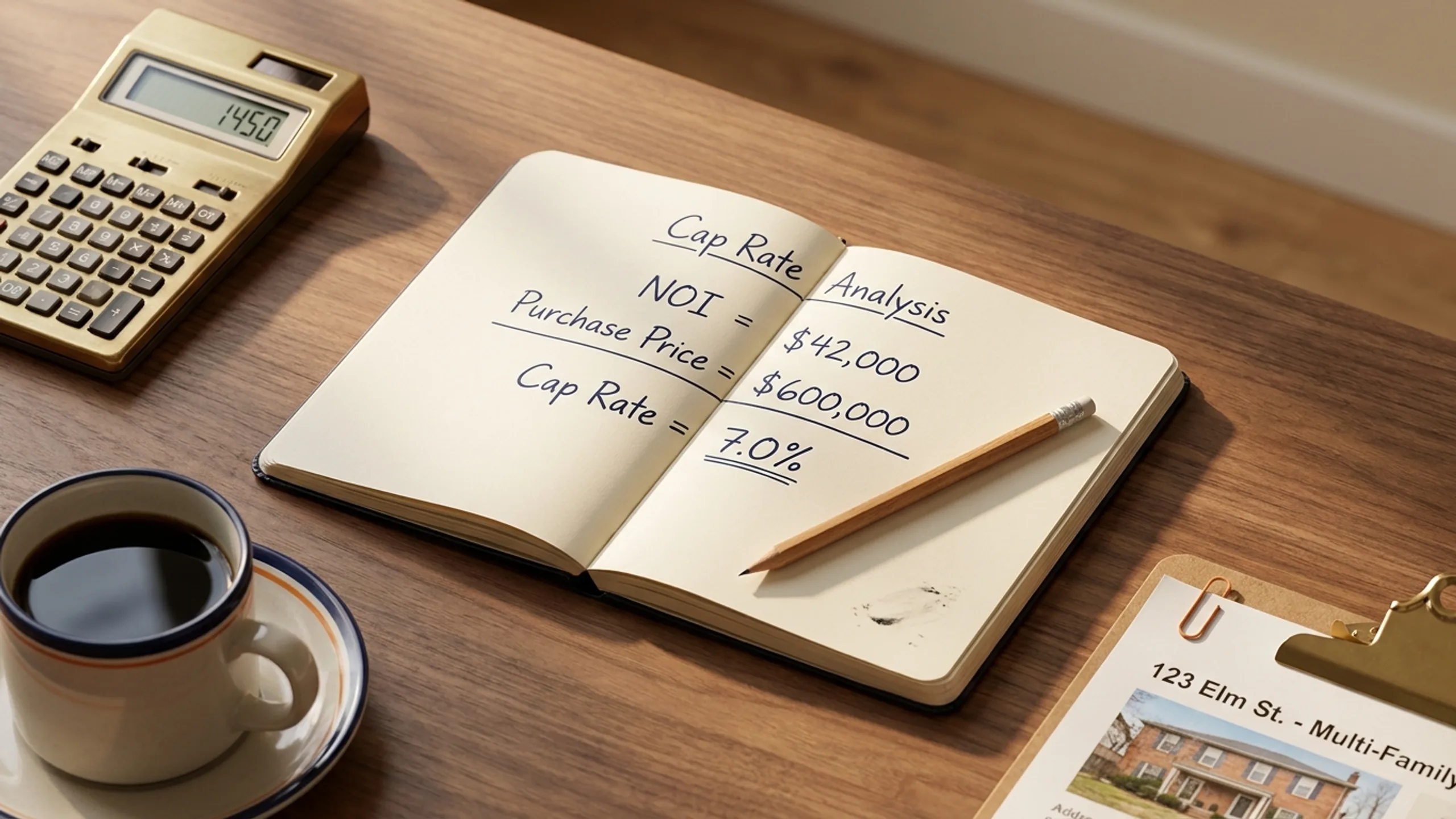
Cap Rate (capitalization rate) is the property's NOI divided by its purchase price, expressed as a percentage. For the full walkthrough, see how to calculate cap rate. Briefly:
Cap Rate = (NOI ÷ Purchase Price) × 100
A 7% cap rate means the property's operating income equals 7% of its value annually. Higher cap rates mean better returns (but often higher risk).
Worked example: same property, both metrics
Let's use a $200,000 duplex in Indianapolis. Both sides rent for $1,100/month, so annual gross rent is $26,400. Operating expenses (taxes, insurance, management, reserves) total $10,836/year, so NOI is $15,564.
GRM calculation
GRM = $200,000 ÷ $26,400 = 7.58
This property has a GRM of 7.6. In other words, gross rent would take 7.6 years to equal the purchase price (before considering any expenses).
Cap rate calculation
Cap Rate = ($15,564 ÷ $200,000) × 100 = 7.78%
This property has a cap rate of 7.78%. Or, the property generates an unleveraged 7.8% annual return on its purchase price after operating expenses.
What both numbers tell you
For this property, both metrics indicate a solid Midwest cashflow opportunity. The GRM under 8 is favorable. The cap rate near 8% is healthy. Both metrics agree this is a workable deal.
But notice: the GRM doesn't tell you anything about how expensive the property is to operate. If property taxes were 2.5% (New Jersey level) instead of 1.05% (Indiana), our operating expenses would be $13,736 instead of $10,836, dropping NOI to $12,664 and cap rate to 6.3%. The GRM would be unchanged.
This is the GRM's blind spot: it can make two properties look equivalent when one has dramatically higher operating costs.
The napkin-vs-spreadsheet analogy
GRM is a back-of-napkin estimate. Cap rate is a financial statement.
Use GRM when you're scanning 30 listings on a Saturday morning and need to skip the obvious losers fast. Use cap rate when you've narrowed to 3 properties and need to make a real decision.
Both are useful. They serve different stages of the buying process.
When GRM is the right tool
1. Fast screening. You're scrolling Zillow and want to filter 50 listings down to 10 in 5 minutes. GRM only needs price and rent, both of which are usually visible in the listing. You can compute it in 5 seconds.
2. Single-family rentals. Single-family operating expenses are reasonably predictable (a 3-bedroom is a 3-bedroom whether it's in Cleveland or Memphis). GRM works well as a comparator across these properties because the expense ratios don't vary much.
3. Markets you know well. If you've been investing in a specific metro for years, you know what GRM levels typically translate to what cashflow. In that case, GRM gives you 80% of the answer in 5% of the time.
4. Initial market comparisons. Comparing Atlanta GRMs vs Cleveland GRMs across listings gives you a quick sense of which market has more income relative to price.
When cap rate is the right tool
1. Anything you're seriously considering buying. GRM filters; cap rate decides. Always run cap rate on properties you're close to making an offer on.
2. Multifamily (5+ units) and commercial. These have variable operating expenses (common area maintenance, vacancy, leasing commissions) that GRM ignores. Commercial brokers operate exclusively in cap rates for this reason.
3. Markets with unusual cost structures. New Jersey and Texas have very high property taxes. Florida coastal has high insurance. California has rent control. In any market with a non-standard expense structure, GRM lies and cap rate doesn't.
4. Cross-market comparisons of similar properties. A 7% cap rate in Cleveland and a 7% cap rate in Phoenix mean roughly the same actual return. A 10 GRM in Cleveland and a 10 GRM in Phoenix can mean dramatically different returns because of how expenses scale.
For step-by-step deal analysis using both metrics, see how to analyze a house hack before you buy.
Common mistakes with both metrics
Treating GRM as a buying criterion. A property with a GRM of 8 looks better than one with a GRM of 10, but if the GRM-8 property has triple the operating costs, the GRM-10 property might cashflow better. Always confirm with cap rate before making any offer.
Using gross rent instead of effective gross income for GRM. The standard GRM uses listed gross rent (assuming 100% occupancy). For your own analysis, consider using "Effective GRM" with vacancy adjusted in. It's not a published metric but it's a more honest one.
Comparing cap rates across radically different markets without context. A 5% cap rate in San Francisco and an 8% cap rate in Cleveland both have legitimate reasons. SF has appreciation potential; Cleveland has cashflow. Use cap rate for property-level decisions, but pair it with strategy clarity for market-level decisions.
Ignoring both metrics in favor of "the deal feels right." Real estate is an asset class where the math has to work. Gut feel can complement the numbers; it can't replace them.
Frequently Asked Questions
Is GRM or cap rate more accurate?
Cap rate is more accurate because it includes operating expenses. GRM only uses gross rent and ignores everything else. Two properties with identical GRMs can have wildly different actual returns once you account for property taxes, insurance, and maintenance. Use GRM for fast initial screening, cap rate for serious analysis.
What's a good GRM for a rental property?
Lower is better (cheaper relative to rent). For most U.S. residential rentals, a GRM of 8-12 is workable. Below 8 means strong cashflow potential (rare in 2026). Above 16 means weak yields, often appreciation-focused markets. The "good" GRM varies dramatically by market and property type.
Can you use GRM for any property type?
GRM works for any income-producing property: single-family rentals, multifamily, commercial. It's especially useful for single-family rentals where cap rate is sometimes considered overkill (because operating expenses are simpler). Cap rate is more standard for multifamily and commercial because the operating expense detail matters more there.
Why don't commercial brokers use GRM?
Commercial properties have more variable operating expenses (vacancy, common area maintenance, leasing commissions, tenant improvements). GRM, which ignores all of these, would mislead commercial buyers. Cap rate, which incorporates them via NOI, is the standard. For residential, where expenses are more predictable, GRM remains a useful quick filter.
How do I convert between GRM and cap rate?
There's no clean conversion because they use different denominators (gross rent vs NOI). You can approximate: if you assume operating expenses are 50% of gross rent (the 50% rule), then NOI is half of gross income, and cap rate is roughly 1 / (GRM × 2). So a GRM of 10 implies a cap rate around 5%. This is rough; real expenses vary.
Should I rely on GRM for buying decisions?
No, but it's useful as a fast first filter. Use GRM to skip listings that are obviously overpriced relative to rents (very high GRMs in your market). For properties that pass the GRM filter, run full cap rate and cashflow analysis before making any offer. GRM saves time on shopping; cap rate decides what to buy.
GRM is the right metric for the first filter. Cap rate is the right metric for everything after that. Use them together for the full picture. The free PDF guide has a one-page worksheet that walks through both calculations side by side. The 28-day course covers deal analysis in week 4 with both metrics built into every example.
This article is education, not financial, legal, or tax advice. Real estate carries risk, and the numbers here are examples. Check them against your own market and talk to a licensed professional before you buy.