In this article7 sections
A HELOC for investment property is a Home Equity Line of Credit secured by real estate you own (most commonly your primary residence) used to fund a new rental property purchase or renovation. The pitch from banks is "tap your equity, deploy it productively." The reality is more nuanced. HELOCs are useful tools for the right situation and dangerous for the wrong situation, and most beginner-targeted articles glaze over the dangerous half. This article walks through how HELOCs actually work for rental investing, when they make sense, and when the variable-rate trap turns a good idea into a forced sale.
This article is for first-time investors weighing whether to use HELOC equity from a primary home (or an existing rental) to fund their next rental purchase. If you have a "the equity is just sitting there" feeling, you're in the right place. The honest answer is sometimes that feeling is right, sometimes it's the same feeling that gets investors over-leveraged into a rate cycle.
Key Takeaways
- HELOCs are variable-rate, draw-against-equity credit lines. You only pay interest on what you use.
- Investment-property HELOCs (against a rental you already own) are harder to get than primary-residence HELOCs.
- Primary-residence HELOCs are easier to get but expose your home to investment risk.
- The variable-rate trap: rates can rise 2-4% over a 5-10 year draw period. Cashflow that worked at 6% may not work at 9%.
- HELOCs work well as bridge financing for BRRRR; they work poorly as the primary financing for a long-term hold.
How a HELOC works
A HELOC is a revolving credit line secured by real estate. You're approved for a maximum draw amount (the credit limit). You can borrow against that limit, repay, and re-borrow, similar to a credit card.
Two phases:
- Draw period (5-10 years): you can draw funds and pay interest-only on the outstanding balance. The credit line remains revolving.
- Repayment period (10-20 years): the credit line closes. You repay principal plus interest on the outstanding balance over the repayment term.
Rates are typically variable, indexed to the prime rate plus a margin. Per Federal Reserve data on prime rate, prime has fluctuated between 3.25% and 8.50% over the past 15 years. A HELOC at "prime + 1%" can swing from 4.25% to 9.50% depending on the rate cycle.
You only pay interest on the amount drawn. If your credit limit is $100,000 and you draw $30,000, your interest charge applies only to the $30,000.
Primary-residence HELOC vs investment-property HELOC
The two are mechanically similar but functionally different.
Primary-residence HELOC (most common):
- Easier to qualify for (650-680 credit minimum)
- Up to 80-85% combined LTV (primary mortgage + HELOC)
- Typical rate: prime + 0% to 2%
- The collateral is your home
Investment-property HELOC (less common):
- Stricter qualification (700-720 credit minimum)
- Capped at 70-75% combined LTV
- Typical rate: prime + 2% to 4% (1-2% higher than primary)
- Available from a smaller pool of lenders (Citizens, Spring EQ, BMO, regional credit unions)
Per Federal Reserve survey data on HELOC originations, HELOCs on investment properties make up a small fraction of total HELOC originations. Most banks don't offer them at all. When they do, the tax treatment also differs: interest on a primary-residence HELOC may be deductible under IRS Publication 936, while investment-property HELOC interest typically flows to Schedule E as a rental expense.
The functional difference: a primary-residence HELOC puts your home on the line; an investment-property HELOC puts only the rental on the line.
Qualification requirements
Both types require:
- Existing equity (15-30% in the property after the HELOC draw is committed)
- Income documentation (W2 or tax returns; some HELOC lenders accept DSCR-style income on rentals)
- DTI under 43% for primary, often 40% for investment
- Cash reserves (3-6 months PITI on the collateral property and the new property)
Primary-residence HELOC specifics:
- 650-680 credit minimum
- Combined loan-to-value (CLTV) up to 80-85%
- Closing costs $0-$1,000 (much lower than a traditional refinance)
Investment-property HELOC specifics:
- 700-720 credit minimum
- CLTV capped at 70-75%
- Closing costs $500-$2,500
- Often a personal guarantee even if the property is in an LLC
When a HELOC helps
Bridge financing for BRRRR. You buy a distressed property with cash from a HELOC draw, rehab it, refinance into a long-term loan, and pay back the HELOC. Total HELOC exposure is 6-12 months. This is the highest-leverage HELOC use case for investors. See BRRRR method real estate explained. For a product underwritten on the property's rent instead of your income, see DSCR loans for rental property.
Down payment on a new property when interest rates have dropped. If you have HELOC capacity at 7% and the new conventional investment rate is 7.25%, the HELOC is a useful bridge until you stabilize the new property. Refinance the HELOC out within 12-24 months.
Renovation financing on an existing rental. If your existing rental needs $30,000 in capital improvements (new roof, HVAC, kitchen) and you don't want to do a full cash-out refi, a HELOC against that rental is a clean tool.
Short-term liquidity for an unexpected opportunity. A great deal appears and you have 30 days to close. A pre-existing HELOC line lets you draw fast.
In all of these uses, the HELOC is a tool with a clear repayment plan and a defined exposure window. That's the right way to use it.
When a HELOC traps you
Long-term financing on a buy-and-hold rental. You buy a property using HELOC cash, plan to hold for 10 years, and rates rise from 7% to 10% in year 3. Your interest payments increase by $250-$500/month, eating cashflow. This is the variable-rate trap.
Tapping primary-residence equity for a first investment. If the new rental fails (vacancy, eviction, market downturn), you have to service the HELOC out of personal income to protect your home. Foreclosure on a HELOC means losing your primary residence to satisfy an investment-property failure. The brand calls this Mistake #10: mixing personal and business finances at the worst possible moment. See Mistakes #10.
Stretching to overpay. "I have HELOC capacity, so I can stretch on this offer." HELOC capacity is not free money. Stretching on price to use HELOC capacity is the Overpaying mistake (see how to avoid overpaying for a rental property) wearing different clothes.
Using HELOC during a falling-rate cycle. If you draw on a HELOC when rates are 9% and you could refinance the new rental into a conventional 7% loan in 6 months, the HELOC interest is wasted. Time the draw to your refinance plan, not to the moment you have the capacity.
The HELOC is a tool. Tools used outside their intended use cases create damage.
HELOC vs cash-out refi vs personal loan
| Tool | Rate type | Closing costs | Best use |
|---|---|---|---|
| HELOC | Variable | $0-$2,500 | Short-term bridge, BRRRR, renovation |
| Cash-out refinance | Fixed | $4,000-$10,000 | Long-term capital deployment, fixed payment |
| Personal loan | Fixed (high) | $0-$500 | Last resort; rates 9-15% |
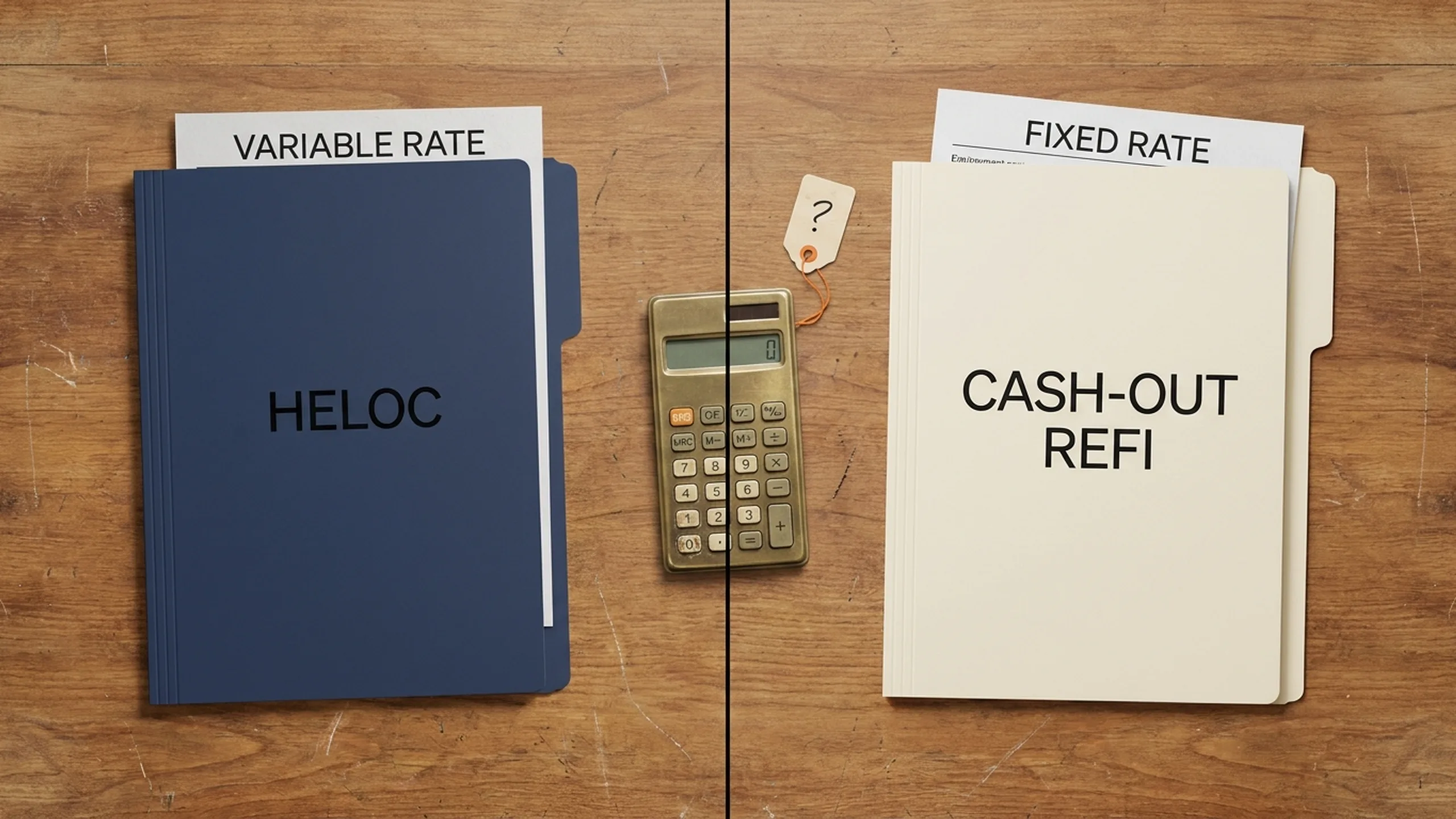
The choice between HELOC and cash-out refi is mostly a duration question. Sub-12-month exposure: HELOC. Multi-year hold of the deployed capital: cash-out refi.
Frequently Asked Questions
Can you get a HELOC on an investment property?
Yes, but it's harder than a primary-residence HELOC. Investment-property HELOCs require higher credit (700-720 minimum), lower combined LTV (70-75% cap vs 80-85% on primary), and are offered by a smaller pool of lenders. Rates are typically 1-2% higher than primary-residence HELOCs.
Why is HELOC harder to get on an investment property?
Lenders price for default risk, and U.S. borrowers default on rental property mortgages at higher rates than on primary residences. Per Federal Reserve research, the gap is consistent across rate cycles. Lenders compensate by requiring higher credit, more equity, and stricter income documentation on investment-property HELOCs.
Can I HELOC my primary to buy a rental?
Yes, technically. Whether you should is a different question. If the rental works on its own, the HELOC is short-term bridge financing and you refinance it into permanent financing on the rental within 12-24 months. If you're using primary-residence equity as long-term financing on a rental, you're putting your home on the line for an investment that might not work, which is generally a poor risk allocation.
What credit score do I need for an investment-property HELOC?
700-720 minimum at most lenders. Best rates start at 740+. Below 700, your options narrow significantly; some non-bank lenders accept 680+ but at higher rates and lower LTV. Combined with the 70-75% CLTV cap, the effective qualification bar is meaningfully higher than for a primary-residence HELOC.
Are HELOC interest rates variable?
Almost always yes. HELOCs are typically indexed to the prime rate plus a margin. Prime has fluctuated 3.25%-8.50% over the past 15 years per Federal Reserve data, which translates to a HELOC rate range of roughly 4.25%-10.50% over the same period. Some lenders offer fixed-rate conversion options on draws, but the default product is variable.
Should I use a HELOC or cash-out refinance to buy a rental?
If your exposure window is under 12 months (BRRRR bridge, short-term liquidity), HELOC. If you're deploying capital for a multi-year hold, cash-out refinance. The fixed rate on a cash-out refi protects you from rate-cycle exposure, which is the single biggest HELOC risk on long-term investment use cases.
A HELOC is a tool. The right use cases are short-term bridges (BRRRR, renovation, opportunistic close). The wrong use cases are long-term financing on a buy-and-hold rental and tapping primary-residence equity to compensate for stretched cash. See how to finance a rental property for the full path comparison. The 28-day course walks through the financing decision in week 3.
This article is education, not financial, legal, or tax advice. Real estate carries risk, and the numbers here are examples. Check them against your own market and talk to a licensed professional before you buy.