
In this article6 sections
Is real estate passive income? The honest answer: more passive than active, but not "set it and forget it." A typical buy-and-hold rental with a property manager takes 1-3 hours per month of owner involvement after the first year. That's far less active than running a business but meaningfully more active than collecting a stock dividend. Calling it "passive" is technically correct in tax terms but practically misleading. This article quantifies the actual time involvement so first-time investors can decide whether real estate fits their definition of passive.
This article is for first-time U.S. investors evaluating real estate against truly passive alternatives like REITs, dividend stocks, or syndications. If you've heard "real estate is passive income" and felt skeptical, you're in the right place. The honest answer is the skepticism is warranted; "passive" in real estate means closer to 12-50 hours per year per property, not zero.
Key Takeaways
- The IRS calls it passive activity for tax purposes. That doesn't mean it requires zero work.
- Realistic owner time: 1-3 hours/month with a property manager, 5-12 hours/month self-managed.
- Truly passive alternatives (REITs, syndications) exist but produce lower returns and lose direct-ownership tax advantages.
- The "passive enough" reframe is more useful than yes/no on the passive question.
What "passive" actually means in real estate
The word "passive" gets used three different ways in real estate content, and conflating them creates confusion:
1. IRS tax classification. Per IRS Publication 925 on passive activity rules, rental real estate is generally classified as a passive activity. This affects how losses can offset income (passive losses generally only offset passive income). It is a tax-treatment label, not a time-involvement claim. It helps to know what the average property actually yields before judging the workload. Our rental property statistics put the national gross figure in context.
2. Active management vs passive management. A self-managed rental is "active" in operational terms. A professionally-managed rental is "passive" in operational terms. The same property can be either, depending on the owner's choice.
3. Truly passive (zero owner time). No money decision is truly zero-time. Even REITs and index funds require initial vetting, periodic rebalancing, and tax filing.
Most casual use of "passive income" implies meaning 3 (zero work). Real estate satisfies meaning 1 (tax classification) and meaning 2 (with property management). It does not satisfy meaning 3.
The realistic time involvement
Honest hour budget for a single rental property in steady state (after year-one setup):
Self-managed buy-and-hold (single-family rental):
- Tenant communication: 0-3 hours/month (most months zero)
- Maintenance coordination: 1-2 hours/month
- Bookkeeping and rent collection: 1-2 hours/month
- Annual tasks (lease renewal, tax prep, inspection): 4-8 hours/year
- Monthly total: 5-12 hours
Property-managed buy-and-hold (single-family rental):
- Approving major repairs: 0-1 hour/month
- Reviewing monthly statements: 30 minutes/month
- Annual tasks (renewal approval, tax prep): 2-4 hours/year
- Monthly total: 1-3 hours
Short-term rental (self-managed):
- Guest messaging: 5-15 hours/month
- Cleaning team coordination: 2-4 hours/month
- Dynamic pricing review: 1-3 hours/month
- Listing optimization, reviews: 1-3 hours/month
- Monthly total: 9-25 hours
Per the Bureau of Labor Statistics American Time Use Survey, the median U.S. adult spends about 5 hours per day on leisure and sports. A property-managed rental at 1-3 hours/month uses less than 1% of that available time.
For activity-by-activity detail, see how many hours does a rental property take.
Comparison: real estate vs truly passive alternatives
| Asset | Time/year | 10-year return (typical) | Leverage available | Tax treatment |
|---|---|---|---|---|
| Direct rental + PM | 12-36 hrs | 8-12% annualized | Yes (75-80% LTV) | Schedule E, depreciation |
| Direct rental self-mgmt | 60-150 hrs | 9-15% (if managed well) | Yes (75-80% LTV) | Schedule E, depreciation |
| Real estate syndication | 5-10 hrs (vetting) | 6-12% | Indirect (sponsor) | K-1 |
| REIT (publicly traded) | 1-3 hrs | 7-10% (S&P RE index) | None | 1099-DIV |
| S&P 500 index fund | 1-3 hrs | 7-10% historical | None | 1099-DIV |
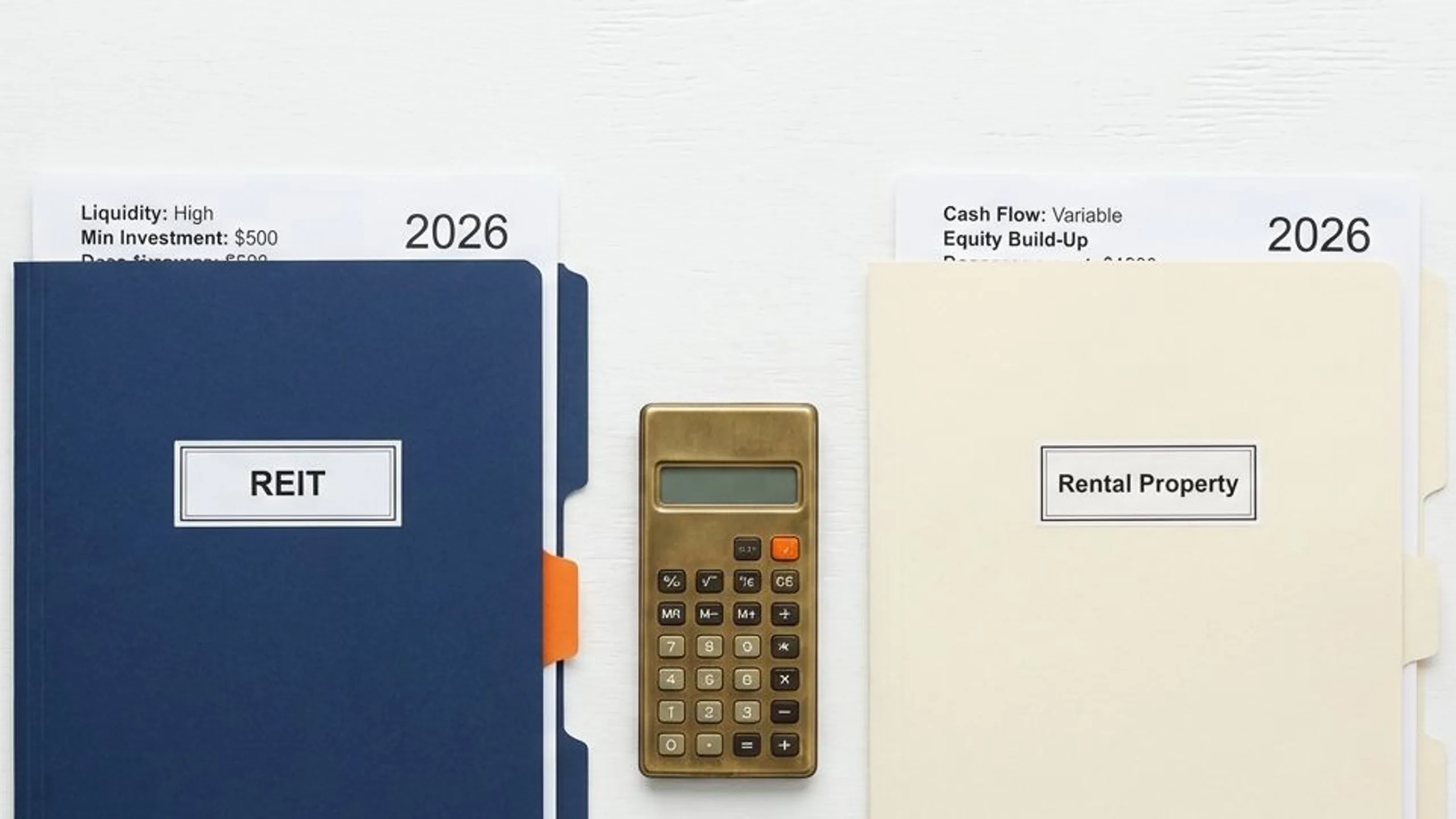
The "pure passive" tier (REITs, syndications, index funds) produces real returns with very little time commitment. Direct rental ownership requires more time but produces meaningfully higher returns when leverage and depreciation are factored in. If you are weighing the two directly, see REIT vs. rental property for returns, time, and control side by side.
The honest tradeoff: paying ~30 hours/year for a property manager buys you direct-ownership returns at near-passive time involvement. That's the sweet spot for most working investors.
What makes real estate more or less passive
The same property can require 5-12 hours/month or 1-3 hours/month, depending on three structural decisions:
Decision 1: Who manages it. Property manager (8-12% fee + one month placement) saves the bulk of operational time. Self-management saves the fee but consumes the time. See property manager vs self-manage rental.
Decision 2: What kind of tenant. Long-term lease tenants in B+ class properties produce 0-3 maintenance calls per year and 12-month renewals. Short-term/STR guests produce 50-200 turnover events per year. C-class properties produce 5-15 maintenance calls per year and more turnover.
Decision 3: How structured your systems are. Written tenant-screening criteria, separate bank accounts, accounting software (Stessa, Hemlane), and a known maintenance contact all reduce per-incident time substantially. Unstructured operations turn every issue into a 1-3 hour project.
Per HUD Fair Housing Act compliance guidelines, screening criteria must be applied uniformly; this requirement also creates time-saving structure.
The "passive enough" reframe
A more useful question than "is it passive?" is "is it passive enough?"
Passive enough usually means:
- The activity doesn't conflict with your primary career
- Time involvement scales sub-linearly with portfolio size (3 properties take less than 3x the time of 1)
- You can take a 2-week vacation without operations breaking
- Your spouse or partner could handle a true emergency in your absence
By that standard, property-managed buy-and-hold rentals usually qualify. Self-managed rentals near where you live usually qualify after year-one. Self-managed long-distance rentals often don't qualify. Short-term rentals require active operation regardless.
The 28-day course covers the systems that make rentals genuinely passive-enough in week 4, including the tenant-screening and property-manager-selection frameworks that prevent operations from sliding back to second-job territory.
For comparison against other strategies, see real estate investing strategies compared and first time landlord mistakes for the operational mistakes that turn passive into active.
Frequently Asked Questions
Is rental property income considered passive income?
Per the IRS, yes for tax purposes. Rental real estate is generally classified as a passive activity per Publication 925, which affects how losses offset income. In practical terms (time spent), rental income is more passive than active business income but more active than dividend income. With a property manager, owner time is typically 1-3 hours per month per property.
How much time does a rental property actually take per month?
Self-managed: 5-12 hours per month per property in steady state (after first-year setup). Professionally managed: 1-3 hours per month per property. Short-term rentals require 9-25 hours per month even with cleaning teams. The time scales sub-linearly with portfolio size for managed properties; 3 properties usually take 3-6 hours per month total.
What's the difference between passive and active income for real estate?
Tax-classification difference: passive activity income gets passive tax treatment (losses offset passive income only, with exceptions like the STR loophole). Active business income gets ordinary-income treatment plus self-employment tax. Most rentals are passive; STRs with substantial services and flips are active. The classification affects taxes, not whether the activity actually requires work.
Is real estate more passive than dividend stocks?
No. Dividend stocks require essentially zero ongoing involvement after purchase; rentals require 1-25 hours per month depending on management approach. Real estate produces higher long-term returns when leverage and depreciation are factored in, which is the trade-off. For pure passivity, dividend stocks and REITs win; for risk-adjusted leveraged returns, direct real estate wins.
Can real estate be truly passive income?
Not via direct ownership. The closest paths to true passivity in real estate are: REITs (publicly traded, 1-3 hrs/year), real estate syndications as a limited partner (5-10 hrs of vetting plus minimal ongoing time), or REIT-like ETFs in a brokerage account. All produce lower returns than direct ownership but require effectively zero operational involvement.
What makes some rental properties more passive than others?
Three factors: (1) management approach (property manager removes most time involvement), (2) tenant quality and lease structure (long-term leases in B+ class properties produce minimal contact), and (3) operational systems (screening criteria, separate accounts, known maintenance contacts). The same property can require 5x more time without these structural choices in place.
The honest answer: real estate is passive enough for most working investors who use property management, particularly after year-one. It is not passive enough if you self-manage long-distance, run STRs, or skip operational systems. The 28-day course walks through choosing the right level of "passive enough" for your situation in week 4.
This article is education, not financial, legal, or tax advice. Real estate carries risk, and the numbers here are examples. Check them against your own market and talk to a licensed professional before you buy.