
In this article10 sections
- Quick comparison table
- Strategy 1: Buy-and-hold (the brand-default)
- Strategy 2: House hacking (buy-and-hold's beginner-friendly cousin)
- Strategy 3: BRRRR (buy, rehab, rent, refinance, repeat)
- Strategy 4: House flipping (active income, not investing)
- Strategy 5: Wholesaling (legal-but-overhyped)
- Two strategies worth a brief mention
- How to choose your first strategy
- Common mistakes when choosing a strategy
- Frequently Asked Questions
Most "real estate investing strategies" guides treat every option as equally viable. They aren't. Some strategies suit complete beginners; others should be avoided until you've done 3-5 deals. Some require minimal capital; others need serious savings. Some are part-time-friendly; others are full-time businesses pretending to be investing. This guide compares the five strategies most beginners encounter with honest assessments of capital, time, and risk for each.
This article is for first-time investors trying to figure out which strategy actually fits their situation. If you've watched a YouTube guru and felt overwhelmed, you're in the right place. We'll skip the hype and walk through what each strategy realistically takes to execute. By the end, you'll know which one to start with and which to ignore for now.
Key Takeaways
- Buy-and-hold is the calm default for most beginners. Lower drama, better tax treatment, time forgives mistakes.
- House hacking is buy-and-hold's beginner-friendly cousin. Owner-occupied financing makes it the lowest-capital path in.
- BRRRR is buy-and-hold with a renovation step bolted on. Higher returns when it works, more ways to fail.
- Flipping is a business, not investing. Active income, active taxes, full-time energy required.
- Wholesaling is legal in most states but heavily oversold. Realistic incomes are below what guru content claims.
Quick comparison table
| Strategy | Capital needed | Time required | Income type | Realistic 5-year return | Best for |
|---|---|---|---|---|---|
| House hacking | $20-30k | 5-15 hr/month | Reduces housing cost | High (lifestyle hack) | Anyone under 35, urban worker |
| Buy-and-hold | $40-80k | 2-5 hr/month per property | Passive-ish rental income | 8-12% annualized | Long-term wealth building |
| BRRRR | $30-60k initially | 50-100 hr per deal | Rental + recycled equity | 12-18% (when executed well) | Investors with renovation tolerance |
| House flipping | $50-150k | 100-300 hr per flip | Active income | $25-40k per deal | Full-time investors with construction skills |
| Wholesaling | $1-5k startup, $500-1k/mo marketing | 20-40 hr/week | Active income (commission) | $0-50k/year typical | People who want sales, not real estate |
Strategy 1: Buy-and-hold (the brand-default)
Buy-and-hold is the most common U.S. residential investment strategy by transaction volume per Federal Reserve household real estate data and Fannie Mae's investment property guidelines.
You buy a rental property and hold it long-term (typically 10-30 years). Rent comes in monthly. The property usually appreciates. The mortgage gets paid down. Tax depreciation shelters most of the income. After a decade, you usually have meaningfully more wealth than when you started.
Why it's the default for most beginners:
- Forgiving. Time covers most mistakes; a property bought slightly wrong in 2014 is still worth more in 2024.
- Sustainable. Most landlords spend 2-5 hours per month per property after the first year.
- Tax-advantaged. Depreciation, mortgage interest deduction, and 1031 exchanges compound over time per IRS Publication 527.
- Compatible with a day job, family, and a normal life.
Realistic capital: $40,000-$80,000 for a $200,000-$300,000 property at 20-25% down, plus closing costs and reserves.
Realistic returns: 8-12% annualized over a 5-10 year hold, combining cashflow, appreciation, and mortgage paydown.
For the full breakdown, see buy-and-hold real estate for beginners.
Strategy 2: House hacking (buy-and-hold's beginner-friendly cousin)
You buy a small property (often a duplex), live in one unit, and rent the others. Owner-occupied financing means lower down payments (3.5% with FHA) and better interest rates than pure rentals.
Why it's the easiest entry path:
- Lowest capital requirement of any strategy ($20,000-$30,000 for an FHA-financed duplex).
- Built-in management proximity (you live there).
- Risk is buffered: if rents disappoint, you're still solving your own housing.
Realistic returns: the most useful return is non-financial. You typically reduce or eliminate your housing cost while building equity. After 1-2 years, the property usually converts to a pure rental and looks more like buy-and-hold thereafter.
The full walkthrough lives in house hacking for beginners.
Strategy 3: BRRRR (buy, rehab, rent, refinance, repeat)
You buy a distressed property, rehab it, rent it out, refinance to pull most of your capital back out, and use that capital to do it again. Per Chase's BRRRR explainer, the strategy lets investors recycle capital faster than traditional buy-and-hold. You can model that cycle with the free BRRRR calculator.
When it works: you have access to undervalued properties, you can manage rehab effectively, and your refinance appraisal supports a 75% loan on the post-rehab value (so you can pull out most or all of your initial capital).
Where it commonly fails:
- Rehab budget overruns (15-30% over-budget is typical for first-time renovators).
- Refinance appraisal short (the property doesn't appraise high enough to support the refinance).
- Time underestimate (buying, rehabbing, leasing, and refinancing typically takes 6-12 months, not 3).
BRRRR is buy-and-hold with a renovation business attached. If renovation work isn't your strength, you're better off doing straight buy-and-hold.
The full BRRRR walkthrough is in BRRRR method explained for beginners.
Strategy 4: House flipping (active income, not investing)
You buy a property, renovate it quickly (typically 2-6 months), and sell it for a profit. Per Kiavi's flipping vs holding analysis, typical net flip profits run $25,000-$40,000 per deal.
The honest framing: flipping is a renovation business that uses real estate as the product. The skills you need are project management, contractor relationships, market timing, and renovation cost estimation. None of these overlap meaningfully with the skills of being a long-term landlord.
Tax reality: flip profits are taxed as ordinary income (22-37% federal) rather than capital gains, because the property is treated as inventory by the IRS. This effectively erases 25-37% of your nominal profit before you ever count the cost of your time.
When flipping makes sense:
- You're full-time, with construction or project-management background.
- You have a deep contractor network and a market you understand cold.
- You can sustain a 6-month bad cycle without forced liquidation.
When it doesn't:
- You have a day job and want passive-ish returns.
- You haven't done a renovation before.
- You're hoping a single flip will fund retirement (it won't).
For the full comparison, see house flipping vs buy-and-hold.
Strategy 5: Wholesaling (legal-but-overhyped)
You find an undervalued property, get it under contract with the seller at a discount, then assign that contract to an end buyer (usually a flipper or landlord) for a fee. You never own the property.
The pitch: "No money down, no credit, $5,000-$20,000 per deal." Per multiple wholesaling guides, fees typically run 5-10% of the property value or $5,000-$20,000 per deal.
The honest reality:
- The "no money" claim is misleading. Marketing costs (direct mail, cold-calling lists, virtual assistants) typically run $500-$1,000/month before you close a single deal.
- Most wholesalers don't close consistently. The job is largely sales: cold-calling distressed sellers, building buyer lists, negotiating contracts.
- Several states (notably Illinois and Oklahoma) have passed laws requiring wholesalers to be licensed, with more states moving in this direction. Check your state's specific rules before starting.
- The strategy doesn't build long-term wealth. Each deal is a one-time fee. There's no equity, no appreciation, no tax shelter from depreciation.
Honest take: wholesaling is a marketing business that happens to involve real estate. If you want to learn sales and lead generation, it's a useful early income source. If you want to build long-term real estate wealth, every other strategy on this list does it better.
The full honest take is in wholesaling real estate: a realistic look.
Two strategies worth a brief mention
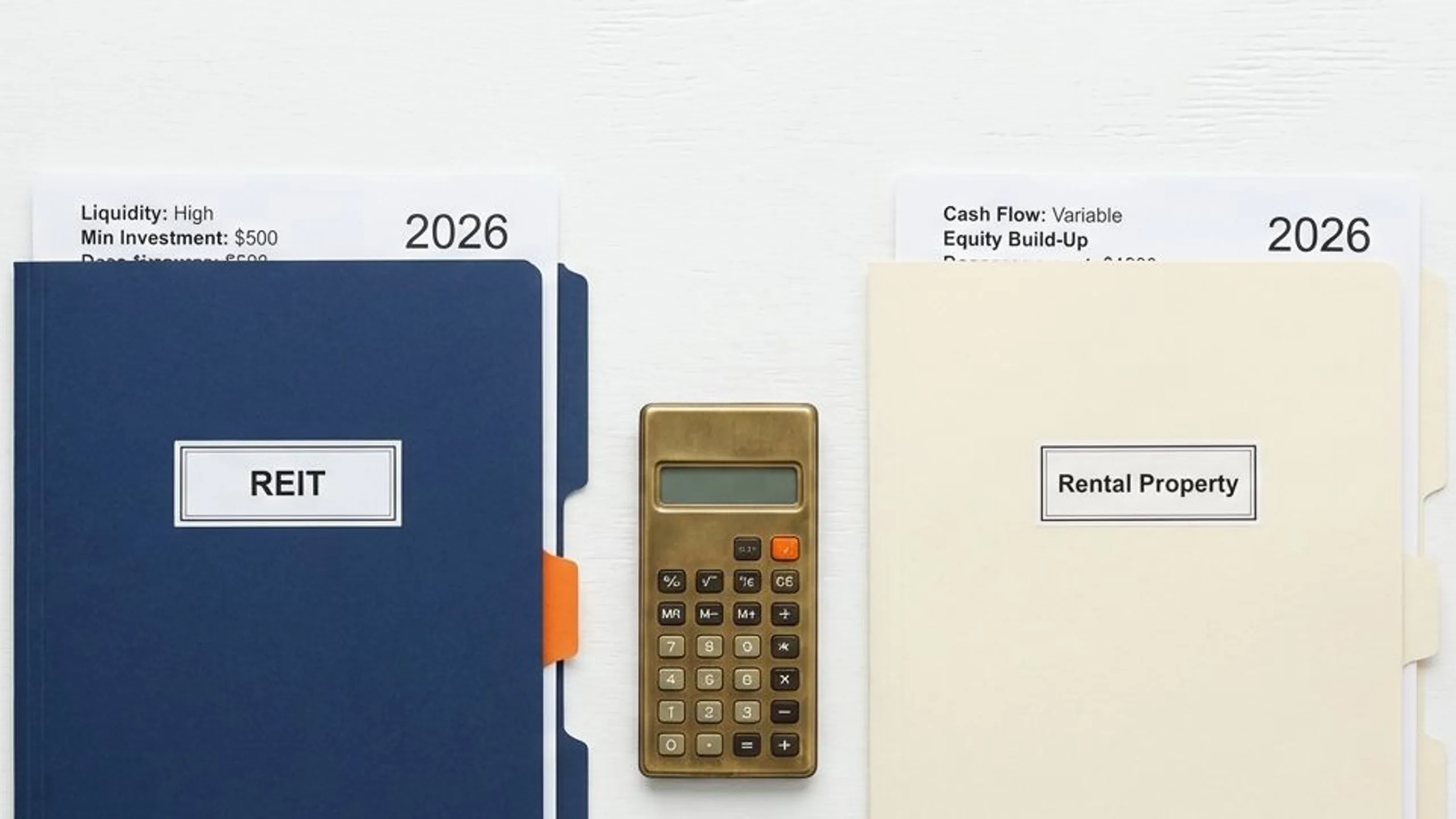
REITs (Real Estate Investment Trusts) are publicly traded companies that own real estate. You buy shares like any stock. You get dividend income tied to real estate but lose the leverage and tax advantages of direct ownership. Useful for portfolio diversification; not a substitute for direct investing.
Real estate syndications are private partnerships where you invest passively as a limited partner. Capital requirement is usually $25,000-$100,000 minimum, and most are restricted to accredited investors. Returns are typically 6-12% with less drama than direct ownership but also no operational learning.
Both are legitimate. Neither is what most beginners need first.
How to choose your first strategy
A simple decision tree:
- Do you have less than $30,000 saved? → House hacking. It's the only strategy that works at this capital level.
- Do you have $40,000+ saved and want a normal life? → Buy-and-hold. Buy a property, hire a property manager if needed, focus on your day job.
- Do you have $50,000+ saved AND love construction projects AND can handle 6 months of stress per deal? → Consider flipping or BRRRR. Otherwise stick with buy-and-hold.
- Do you want to learn sales and lead generation more than real estate operations? → Wholesaling, with realistic expectations.
- Do you want real estate exposure without operational work? → REITs or syndications.
For the full investor-by-investor framework, see how to pick a city for real estate investing (because the strategy and the city interact).
Common mistakes when choosing a strategy
1. Picking based on YouTube videos. Every guru has a strategy that worked for them in their specific market in their specific year. Their results are not your results.
2. Trying multiple strategies at once. Pick one and do 1-3 deals. Then decide whether to expand.
3. Underestimating time required. Every strategy takes more time than it looks online. Plan accordingly.
4. Ignoring tax implications. A 30% return that's taxed as ordinary income beats a 25% return taxed as capital gains only sometimes. Run the after-tax math, especially for flipping and wholesaling.
5. Confusing strategy with deal selection. Picking buy-and-hold doesn't tell you which property to buy. Strategy is the framework; deal analysis happens after. See how to analyze a house hack before you buy for the deal-level math.
Frequently Asked Questions
What's the easiest real estate investing strategy for a complete beginner?
House hacking, by a wide margin. You buy a small property (often a duplex), live in one unit, and rent the others. The financing is easier (FHA at 3.5% down works for owner-occupied), the management is simpler (you live there), and the math forces you to care about cashflow from day one. Most other strategies are harder, riskier, or both.
Do I need a real estate license to start investing?
No. None of the five strategies in this guide require a license. A license helps for some sub-strategies (especially wholesaling and certain flipping setups) and gives you access to MLS data, but it's not a barrier to starting. If you eventually want to do dozens of deals or work with sellers directly, getting licensed pays for itself; for the first 1-3 deals, it's not necessary.
How much money do I actually need to start?
It depends entirely on the strategy. House hacking can start with $20,000-$30,000 (FHA 3.5% down + closing). A buy-and-hold rental usually needs $40,000-$80,000 (20-25% down on a $200k-$300k property). BRRRR needs similar starting capital but recycles it. Flipping needs $50,000-$150,000+ for purchase, rehab, and reserves. Wholesaling needs almost nothing in capital but requires consistent marketing spend ($200-$1,000/month).
Are REITs and syndications real estate investing or something else?
They count as real estate exposure but they're a different game. REITs are publicly traded stocks that own real estate; you can buy them in any brokerage account. Syndications are private partnerships where you're a passive limited partner. Both produce real estate-like returns without the operational work, but they also lack the leverage and tax advantages that drive most direct-investment returns. Treat them as portfolio diversification, not as substitutes for direct investing.
Why is buy-and-hold considered the default for beginners?
Three reasons. First, it's the strategy where time forgives mistakes the most: a property held 10 years usually rises in value even if you bought slightly wrong. Second, the operational work is sustainable around a day job (most landlords spend 2-5 hours per month per property). Third, the tax advantages (depreciation, mortgage interest deduction, 1031 exchanges) compound over time in ways that flipping and wholesaling don't capture.
Should I learn one strategy or try multiple?
One. Pick one strategy and do 1-3 deals before considering another. Beginners who try to flip, wholesale, and buy-hold simultaneously almost always do all three poorly. The skills overlap less than they appear: flipping is a renovation business; buy-and-hold is a tenant operations business; wholesaling is a marketing business. Mastering one before adding another is the dramatically faster path.
The honest answer for most beginners: pick house hacking or buy-and-hold, do 1-2 deals, then decide if a different strategy fits your situation. The strategy that fits is the one that matches the goals you actually wrote down, not the one with the best story. Skip the gurus telling you about $50,000-per-month wholesaling income; those numbers exist but they're not typical. The free strategy guide walks the same comparison in about 10 minutes if you want it on one page. The 28-day course walks through deal selection in week 4 with all five strategies covered.
This article is education, not financial, legal, or tax advice. Real estate carries risk, and the numbers here are examples. Check them against your own market and talk to a licensed professional before you buy.