In this article7 sections
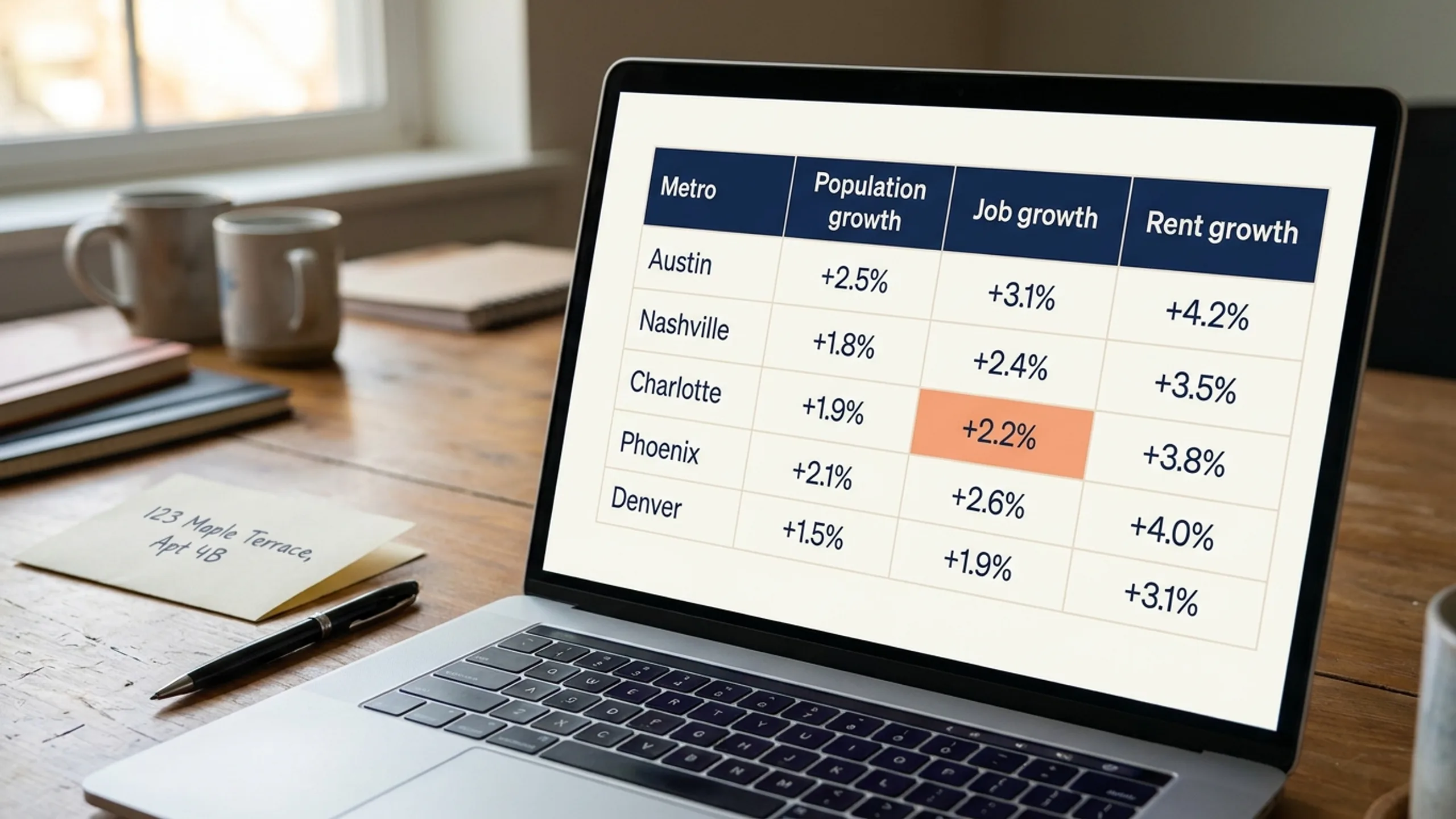
Per Bureau of Labor Statistics regional economic data and U.S. Census Bureau population estimates, every real estate market analysis cites population growth, job growth, and rent growth as the three indicators of market health. They don't all matter equally, and the order matters. Jobs lead population by 18-24 months. Population leads rent by 12-18 months. Rent growth is the last indicator to move. If you're picking a city today, the most predictive number is job growth in stable industries. If a city has those, the population and rent growth typically follow on a 1-3 year lag.
This article is for first-time investors who keep seeing these three numbers in market reports and want to know which one to weight most when picking a city. If you haven't started the city-selection process yet, see how to pick a city for real estate investing for the broader six-step framework.
Key Takeaways
- Order of importance for forecasting: jobs > population > rent.
- Jobs lead by 18-24 months. Companies hire, then workers move, then rents rise.
- Population growth confirms the job thesis but doesn't predict alone. A growing population chasing falling job numbers is a leaving population.
- Rent growth is a trailing signal. By the time rents are rising sharply, the move-in window is usually closed for cashflow buyers.
- Best metric for beginners: 3-year diversified job growth above 1.5% annualized in non-cyclical sectors (healthcare, logistics, education, government).
- All three should be moving in the same direction. Conflicts between them mean read carefully before buying.
Why all three matter (briefly)
Every healthy real estate market has the same fundamental cycle:
- Companies hire workers.
- Workers move to where the jobs are.
- Demand for housing exceeds supply.
- Rents rise. Prices rise. New construction begins.
- Eventually, supply catches up and the cycle stabilizes.
Job growth, population growth, and rent growth are three measurements of the same cycle at different points. Looking at all three tells you where the city is in the cycle. Looking at one alone is incomplete. For how rent stacks up against local pay, see rent-to-income ratios by state. The national figures behind these trends are collected in the 2026 rental property statistics.
The question is: when picking a city to invest in now, which indicator gives you the most useful information about the next 3-5 years?
Indicator 1: Job growth (the leading indicator)
Job growth is the most predictive single indicator for real estate market health. It leads everything else.
The mechanism is concrete. When a Fortune 500 company announces 5,000 new jobs in Columbus, the property market responds in this sequence:
- Months 0-6: announcement made. Land and site purchases by the company. Some early speculative real estate buying.
- Months 6-18: hiring ramps. Workers relocate. Rental demand rises, especially in submarkets near the new facility.
- Months 12-30: rent prices rise 10-25% in affected submarkets. Home prices begin rising.
- Months 24-48: new construction starts. Supply begins to catch up. Rent growth slows.
The whole cascade takes 2-4 years from job announcement to fully-realized rent growth. If you can get in early (during months 0-12), you ride most of the appreciation and rent growth wave. For the national baseline those local numbers should beat, see the rent-trend tables on our rental property statistics page.
Where to find job data: BLS Quarterly Census of Employment and Wages is the authoritative source, updated quarterly with metro-level data. For more current data, regional Federal Reserve banks publish economic snapshots (FRED metro employment series).
What to look for:
- 3-year annualized job growth above 1.5% (national average is around 0.8%)
- Diversification: top 5 employer industries shouldn't represent more than 70% of the workforce
- Specific announced expansions (Intel in Columbus, TSMC in Phoenix area) that haven't fully played out yet
What to avoid:
- Single-industry dominance (oil and gas towns, single-employer towns)
- Job growth that's all in volatile sectors (tech-only metros suffered when interest rates rose in 2022-2023)
Indicator 2: Population growth (the confirming indicator)
Population growth confirms whether the job growth thesis is working. People follow jobs, but only after a lag.
The relationship between job and population growth tells you about the market's quality:
- Jobs growing + population growing: healthy. The market is attracting workers. Buy here.
- Jobs growing + population flat or shrinking: the jobs aren't paying enough to attract movers, OR housing is unaffordable, OR the metro has structural problems (climate, governance, schools). Investigate before buying.
- Jobs flat + population growing: usually retirement migration (Florida) or remote-worker migration (some Mountain West metros). Different demand profile, but can still be a good market.
- Jobs shrinking + population shrinking: avoid. This is the cycle in reverse, and it's hard to predict the bottom.
Where to find population data: U.S. Census American Community Survey 5-year estimates at the metropolitan statistical area (MSA) level. Update annually.
What to look for:
- Net positive migration in 4 of the last 5 years
- Working-age (25-54) population growing at least as fast as total
- Total annualized growth above 1.0% (national average is around 0.5%)
What to avoid:
- Metros with shrinking working-age population, even if total is rising (often retirement-driven, which doesn't grow rental demand for traditional housing).
Indicator 3: Rent growth (the trailing indicator)
Rent growth is what you see after the cycle has played out. By the time annualized rent growth is above 5% in a metro, you've largely missed the entry window for cashflow.
That doesn't mean rent growth is useless for picking a city. It just means you should use it differently than the other two.
How to use rent growth as an investor:
- Recent rent growth above 5% annualized: too late for cashflow buying; either accept appreciation strategy or look elsewhere.
- Recent rent growth 2-5% annualized: healthy market, still a good entry window if you find the right deal.
- Recent rent growth below 1% or negative: market is in oversupply OR job and population growth has stalled. Investigate before buying.
Where to find rent data: Apartment List National Rent Report (monthly), HUD Comprehensive Housing Market Analysis (less frequent but more rigorous), and Zillow's metro-level rent indices.
A useful current example: Apartment List reports that nationally, rents are down 1.7% year-over-year, the lowest growth since 2017. That's a national average masking wide variation. San Jose and San Francisco lead rent growth (driven by AI hiring); Austin shows softening rents because the metro is permitting new construction at the fastest pace of any large metro.
The explicit ranking
For a first-time investor picking a city, here's how to weight each indicator:
| Indicator | Weight | Why |
|---|---|---|
| Job growth (3-year, diversified) | 50% | Leading indicator. Predicts the next 2-4 years of demand. |
| Population growth (5-year, working-age) | 30% | Confirms jobs are attracting movers. Disconfirms when broken. |
| Rent growth (recent 12-24 months) | 20% | Tells you where the market is in its cycle, not where it's going. |
A city with strong jobs + moderate population + low rent growth is in the early phase of the cycle. That's the best entry point for cashflow investors.
A city with strong jobs + strong population + sharp rent growth is in the mid-cycle. Still investable, but margins are thinner.
A city with strong jobs + flat population + flat rents has a problem. Either the jobs aren't real, the housing is unaffordable, or the metro has structural issues. Read carefully before buying.
For specific metros that score well on this composite framework, see best cities for first-time real estate investors in 2026.
Common mistakes
Looking at rent growth alone: a metro with 8% rent growth feels exciting. It's also late. The capital appreciation and rent gains are mostly behind you.
Looking at population alone: Florida retirement metros have huge population growth and weak rental demand for working-age tenants. Population without job context misleads.
Comparing metros to national averages instead of each other: 1% annualized job growth is below national average but above-average for slow-growth Midwest. Context matters.
Ignoring the diversification of jobs: Phoenix and Las Vegas have high job growth but heavy concentration in tourism and construction. Both crash hard in recessions. Diversified job growth (healthcare + logistics + finance + manufacturing) is more durable than concentrated job growth in any one sector.
Frequently Asked Questions
How recent should the data be for these indicators?
Job growth: latest BLS QCEW release (within 6 months). Population: latest Census ACS estimate (within 12 months). Rent growth: monthly indices like Apartment List (within 30 days). Older data is fine for trend analysis but stale for current decisions.
What if my city has strong jobs but rents aren't moving?
Two possibilities. First, the cycle hasn't played out yet (1-3 year lag is normal); rents are coming. Second, supply is keeping up with demand (Austin, current example). Either way, it's a sign to buy soon if the job thesis is real.
Is climate or political risk part of this framework?
Not directly, but it should be. Climate risk affects long-term population trends (parts of Florida and Louisiana have rising climate-driven exit). Political risk affects landlord-friendly state laws. Both are pre-filters before this indicator analysis runs.
How do small metros (under 100,000) fit this framework?
They don't fit cleanly. Small metros have idiosyncratic risk: one factory closing erases the demand thesis. The framework above works best for MSAs above 250,000. For smaller metros, weight job concentration risk much more heavily.
Can rent control or rent caps affect rent growth as an indicator?
Yes. In rent-controlled markets (CA, NY, OR, MD), reported rent growth understates true demand because legal caps suppress the price signal. In those markets, vacancy rate and time-on-market are better demand indicators than rent growth.
What's the difference between gross job growth and net job growth?
Gross is hires; net subtracts losses. BLS QCEW reports net employment change, which is what matters. Headlines about big new hires (a 5,000-job announcement) often miss that the same metro lost 4,200 jobs in another sector. Always look at net.
A city's near-term real estate trajectory is mostly written in its current job growth. Population growth confirms. Rent growth tells you whether you're early or late. Use all three, but weight them in that order. The 28-day course covers metro-level analysis in week 2 with public-data walkthroughs for each indicator. The free PDF guide has a one-page indicator scorecard you can apply to any city.
This article is education, not financial, legal, or tax advice. Real estate carries risk, and the numbers here are examples. Check them against your own market and talk to a licensed professional before you buy.