In this article9 sections
Picking the wrong city is the most expensive mistake a first-time real estate investor can make. The right city carries you for a decade through tenant demand, appreciation, and rent growth. The wrong one drains your savings month after month, no matter how clever your deal analysis is. This guide walks through a six-step framework that uses free public data sources to narrow the U.S. from 1,000+ metros to a shortlist of three you can actually evaluate.
This article is for first-time investors who haven't picked a city yet, or who picked one based on familiarity and now want to validate it with data. If you already have a property under contract, see how to analyze a house hack before you buy for the deal-level math.
Key Takeaways
- Pick your strategy first (cashflow market vs appreciation market). The data you look at depends entirely on which one you want.
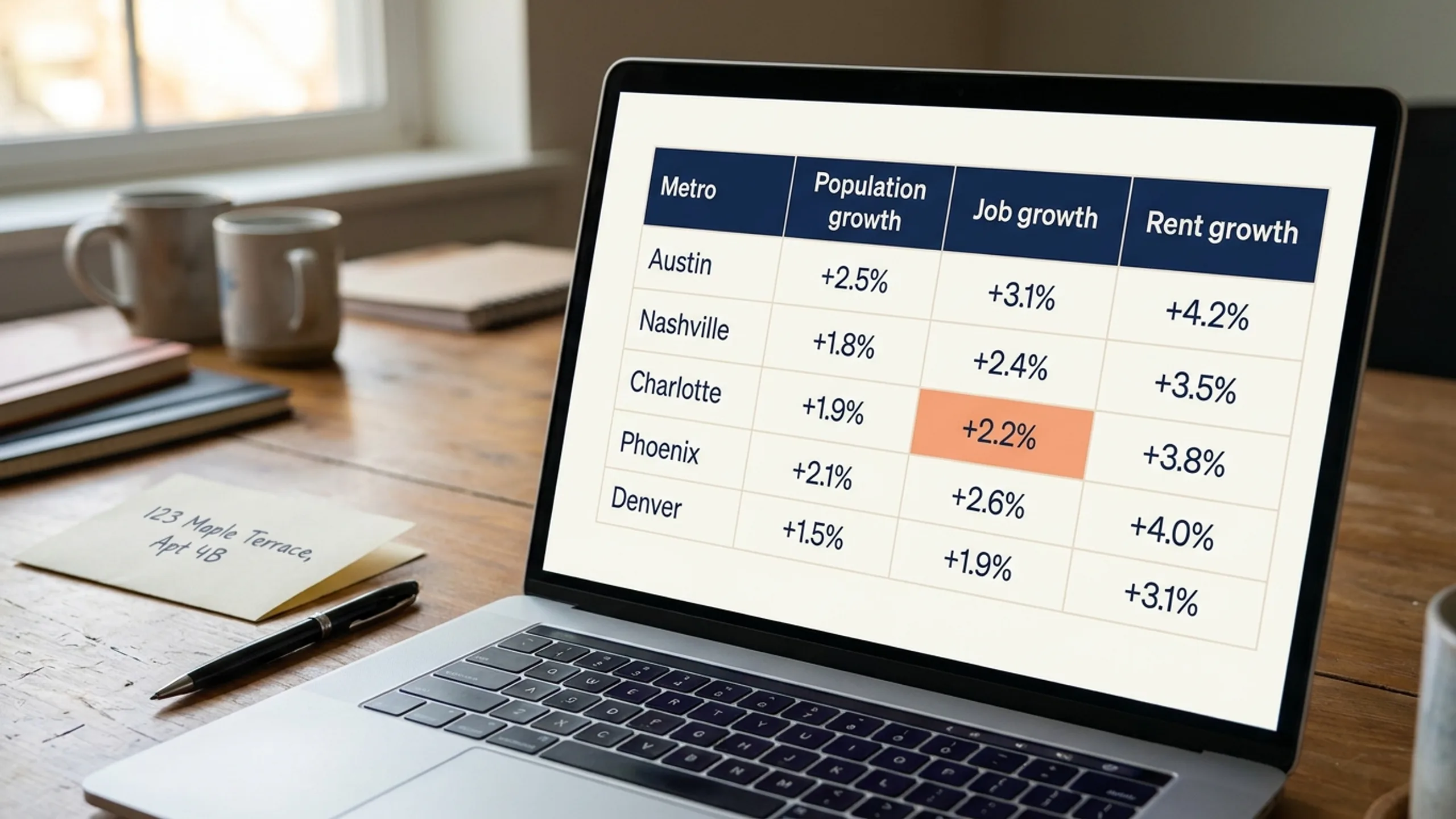
- Population growth: filter to metros with 5+ years of positive net migration per Census ACS.
- Job growth: jobs lead population by 18-24 months. Use BLS Quarterly Census of Employment and Wages to find metros adding jobs in healthcare, tech, logistics, or manufacturing.
- Rent-to-price ratio: target metros where median rent is at least 0.6% of median price (cashflow markets) or where price growth has consistently outpaced rent growth (appreciation markets).
- Landlord-friendly state: eviction timelines, security deposit caps, rent control, and property taxes vary by an order of magnitude between states. Get this right or accept the risk.
- The whole shortlist process should take 4-6 hours, not weeks.
Step 1: Pick your strategy first
The biggest beginner mistake is researching cities before deciding what kind of investment you want. The two strategies pull you in opposite directions:
- Cashflow strategy: you want monthly rent to substantially exceed all costs. Best in lower-cost-of-living metros (Cleveland, Memphis, Birmingham, Indianapolis). Lower appreciation, higher current income.
- Appreciation strategy: you accept low or zero monthly cashflow in exchange for property value growth. Best in fast-growing metros (Austin, Nashville, Tampa, Charlotte). Higher long-term wealth, more sensitive to timing and market cycles.
Most beginners should pick cashflow first. Cashflow is what keeps you in the game when life happens. Appreciation is a bet on the future. Pick one before opening Census data, because the same data tells different stories depending on which you want. For the national baseline to compare any metro against, see the 2026 rental property statistics.
For a deeper read on which property type works best in each strategy, see single-family vs duplex for house hacking.
Step 2: Filter by population trend
Population is the foundation. Without people moving in, every other metric is rented air.
Use the Census American Community Survey 5-year estimates by metro. Look for:
- Positive net migration in 4 of the last 5 years
- Total population growth above 1.0% annualized over 5 years
- Working-age population (25-54) growing at least as fast as total
A metro with growing total population but shrinking working-age population (think Florida retirement communities) has demand for very different real estate than a metro with strong working-age growth (think Raleigh, Salt Lake City, Boise).
Skip metros with negative migration over the past 3 years. They might recover, but you're a beginner. Don't bet on a turnaround.
Step 3: Filter by job growth
Jobs lead population by 18-24 months. Where jobs go, renters follow. Where jobs leave, renters leave faster.
Use the BLS Quarterly Census of Employment and Wages to identify metros adding jobs in stable, recession-resistant sectors:
- Healthcare (most resilient through 2008 and 2020 recessions)
- Education and government (slow but stable)
- Logistics and warehousing (Amazon, Walmart, regional distribution hubs)
- Manufacturing (especially if reshoring incentives are landing in your target metro)
- Tech (high growth but volatile; treat as bonus, not foundation)
Avoid metros with 50% or more of job growth in a single industry, especially commodity-cycle industries (oil, coal, agriculture). When that industry contracts, the metro contracts.
A useful sanity check: pull up a major job board and search "healthcare" or "warehouse" jobs in your target metro. If listings number in the thousands and have been posted recently, the labor market is real. If listings are sparse or stale, the headline job growth might be hype.
For a deeper take on how to weigh these indicators against each other, see population vs jobs vs rent growth.
Step 4: Filter by rent-to-price ratio
For cashflow markets, the rent-to-price ratio is the single most useful filter.
The 1% rule says monthly gross rent should be roughly 1% of purchase price. So a $200,000 property should rent for $2,000/month. Most U.S. metros now fail the 1% rule. That's not a dealbreaker, but if your target metro is below 0.6% (i.e., $200,000 property renting for $1,200), cashflow will be very hard to achieve once you account for vacancy, capex, and management.
Pull median rents from HUD's Comprehensive Housing Market Analysis and median home prices from FRED. Calculate the ratio for each shortlist metro. You're looking for:
- 0.8% or higher for strong cashflow markets
- 0.5-0.8% for moderate cashflow with appreciation upside
- Below 0.5% for appreciation-only plays
Combined with the population and job filters above, this typically narrows the U.S. to 5-15 viable metros for a cashflow strategy.
Step 5: Vet landlord-friendliness
State law shapes how easy it is to operate a rental at scale. Key factors:
- Eviction timeline: ranges from 30 days (Texas, Georgia) to 12+ months (California, New York). Long timelines aren't automatic disqualification, but they require larger reserves and stricter tenant screening.
- Security deposit limits: most states allow 1-2 months' rent. A few cap at one month or zero (NY, MA, CA). Lower caps shift more risk to you.
- Rent control: present in CA, NY, NJ, OR, MD, MN. Rent control isn't always a dealbreaker, but it caps your upside on long-term holds.
- Property tax rates: from 0.32% (Hawaii) to 2.49% (NJ) of assessed value. New Jersey property taxes can erase 4-5% of cashflow on a typical rental.
Cross-reference your shortlist of 5-15 metros against state law. The result is usually a tighter shortlist of 3-5 metros that pass all filters.
Step 6: Drill into 2-3 finalists
Now zoom in. For each remaining metro:
- Visit Zillow and pull 20 active listings in your target price range. Are there enough to choose from?
- Check vacancy rate via HUD CHMA. Ideal: 5-8%. Below 5% means tight supply (good for landlords); above 10% means oversupply (bad).
- Look at school ratings. For long-term family rentals, schools matter; for young-professional rentals, less so.
- Plan a visit. Spend 2-3 days walking neighborhoods. Talk to a property manager. Drive at night. Read the local newspaper. Some metros look great in spreadsheets and disappointing in person.
For neighborhood-level evaluation once you've picked a metro, see how to research a neighborhood before buying.
Common mistakes
Picking the city you live in by default. Sometimes that's the right choice. But assuming it without doing the analysis is how beginners end up over-leveraged in expensive coastal markets where the math has never worked.
Picking the city based on a YouTube video or one investor's success story. That investor bought 7 years ago at 40% lower prices. The market that minted them is not the market you'd buy into today.
Getting paralyzed. A B-grade decision made now beats an A+ decision made in 18 months. Pick a viable metro, buy your first property, learn from operating it. Markets matter, but the first deal is mostly about getting reps.
Ignoring out-of-state options. Many beginners assume they have to invest where they live. They don't. Out-of-state investing comes with management trade-offs but opens 50x more options. See out-of-state vs local real estate investing for the comparison.
A simple decision worksheet
For each candidate metro, score 1-5 on each criterion:
| Criterion | Weight |
|---|---|
| Population growth (5-year, working-age weighted) | 20% |
| Job growth (BLS QCEW, diversified) | 20% |
| Rent-to-price ratio | 25% |
| Landlord-friendly state laws | 15% |
| Property tax rate | 10% |
| Local market depth (active listings, vacancy) | 10% |
Multiply each score by its weight. Highest weighted total wins. Tied? Pick the one you can visit cheaper.
The free PDF guide includes this worksheet plus a one-page market scorecard you can use during city visits.
Frequently Asked Questions
How many cities should I shortlist before picking one?
Aim for 3-5 finalists after Steps 1-4. More than 5 means your filters are too loose; fewer than 3 means you're being over-restrictive. Once you have 3-5 finalists, deep research (Steps 5-6) typically narrows it to 1-2.
Should I invest in my own city or somewhere else?
If your city passes all the filters above, invest there. The local-knowledge advantage is real: lower management cost, faster learning, fewer surprises. If your city fails the rent-to-price or job-growth filters, look elsewhere. Most beginners in expensive coastal cities are better off going out-of-state to a Midwest cashflow market for their first deal. For a worked example of this in one market, see whether Columbus is good for house hacking.
How long should this process take?
The data work in Steps 1-5 takes 4-6 hours total if you're focused. Step 6 (visits) takes 2-4 weekends if you're traveling. From start to short-listed metro: 4-8 weeks. Don't drag it out longer; analysis paralysis is the enemy.
Is it worth paying for tools like Mashvisor or PropStream?
For the shortlist phase (Steps 1-5), no. Public data from Census, BLS, FRED, and HUD is free and authoritative. Paid tools become useful at the deal-screening phase (Step 6 and beyond), where they accelerate property comparisons. As a beginner, learn the public-data tools first; you will use them forever.
What if all my finalist metros fail the 1% rule?
Most U.S. metros now fail the 1% rule, so that alone doesn't disqualify them. Look at the 0.6% threshold instead. If even that fails, you're either in pure-appreciation territory (accept lower cashflow for higher long-term value) or you should expand the shortlist to include cheaper metros. The Midwest still offers many 0.8% or higher markets. If budget is the constraint, start with the cheapest cities to buy a rental property.
How often should I re-run this analysis?
Every 18-24 months for the metros you're already invested in (to confirm the thesis still holds). Every 6 months if you're actively shopping. Markets shift slowly, but they do shift. The metros that were obvious in 2018 (Austin, Phoenix, Boise) are no longer obvious in 2026 because price appreciation has eaten the rent-to-price advantage.
City selection is the highest-leverage decision in your first deal. Done well, it sets you up for a decade of compounding. Done poorly, it locks in years of mediocre returns. Take 4-6 hours to do this right before you spend 100+ hours shopping properties. The 28-day course covers this entire process in week 2 with live data walkthroughs.
This article is education, not financial, legal, or tax advice. Real estate carries risk, and the numbers here are examples. Check them against your own market and talk to a licensed professional before you buy.