In this article9 sections
House hacking, per HUD FHA Handbook 4000.1 classifications of owner-occupied 2-4 unit properties, is the most common way ordinary people buy their first investment property in the U.S., and it's almost never explained simply. The basic idea: you buy a small property, live in part of it, and rent out the rest. Your tenants help cover the mortgage. You build equity on a place you actually live in. And because you're owner-occupying it, you qualify for loan terms a pure investor can't touch.
This article is for first-time investors who keep hearing "house hack" thrown around and want a clear, calm walkthrough: what it actually means, how the financing works, the four ways people do it, and the parts most blogs gloss over.
Key Takeaways
- House hacking = buying a property, living in part of it, renting out the rest. The rent offsets your housing cost.
- FHA loans require as little as 3.5% down and apply to properties with up to 4 units, as long as you live in one.
- You must occupy the property within 60 days of closing and live there at least 12 months under FHA rules (HUD Single Family Handbook).
- There are four common strategies: multi-unit owner-occupy, single-family with rented bedrooms, ADUs, and short-term rental rooms.
- The biggest beginner mistakes are buying a property that doesn't actually cashflow once you move out, and underestimating the work of living next to your tenants.
What house hacking actually means
House hacking is a strategy where you buy a residence, live in one part of it, and rent out the other parts to cover some or all of your mortgage payment. It's not a special loan, a license, or a course. It's just an arrangement of who pays rent and who lives where. If you want the market-level numbers behind the strategy, our house hacking statistics cover how many two-to-four-unit homes exist and where they are concentrated.
The reason it has its own name is that it lets a beginner combine two things that are usually expensive separately: owning a home and starting as a real estate investor. Done well, the rental income from the other part of the property covers most or all of your monthly housing cost. Some people pay nothing out of pocket. Some people get paid to live in their own home.
The "hack" in house hacking isn't a trick or a loophole. It's just the realization that lender rules treat the property you live in very differently from the property you rent out from a distance. And a beginner can use that difference to start building wealth on a property they were going to live in anyway.
Why house hacking is the most common first-deal path
Three reasons it works for beginners specifically:
1. Owner-occupied financing is dramatically easier. When you tell a lender "I'm going to live here," they offer you the best loan products available. FHA loans require as little as 3.5% down for borrowers with credit scores of 580 or higher, and they're available for properties with up to four units. A pure rental investor putting 25% down on the same property gets none of that.
2. Your tenants effectively pay your mortgage. A duplex where each side rents for $1,400 means you collect $1,400 in rent while you live in the other side. If your total mortgage payment (principal, interest, taxes, and insurance) is $1,800, your out-of-pocket housing cost is $400, for a property you own and that's appreciating in your name.
3. You learn landlording with the lowest possible stakes. First-deal mistakes are inevitable. House hacking forces you to make those mistakes ten feet from your own kitchen, where you can fix them quickly. The first time a tenant pays late or a faucet leaks, you're learning property management while still having your day job paying for groceries.
If you are still deciding whether to keep renting at all, the rent vs buy calculator puts both paths on the same timeline. For a step-by-step view of how this fits into the bigger first-deal path, the 28-day course covers financing setup in week 3 and how to underwrite a house-hack property in week 4.
The four ways people house hack
Different properties suit different lifestyles. Most beginners pick whichever is most achievable in their market.
1. Small multi-family (the classic)
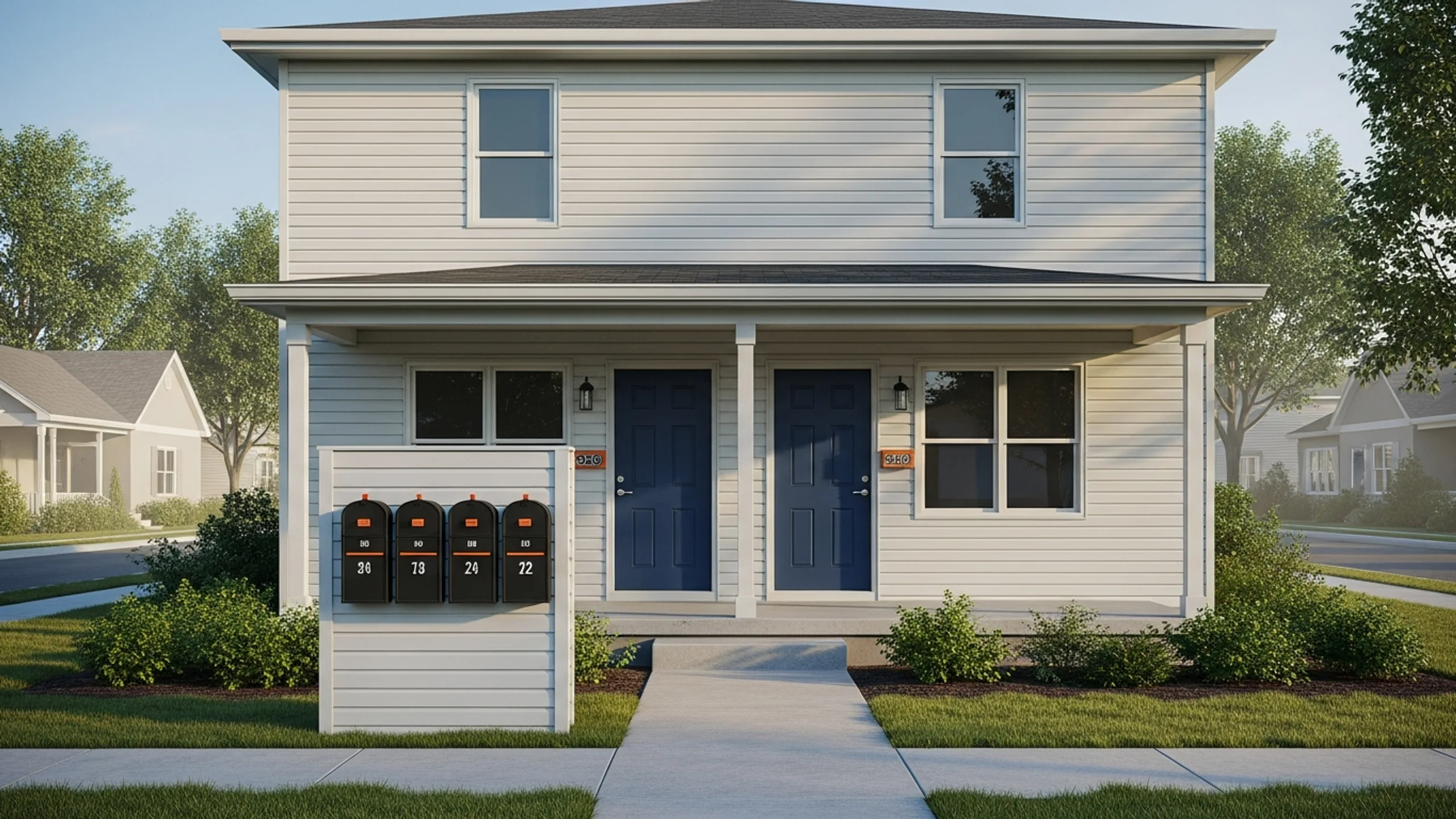
You buy a duplex, triplex, or fourplex. You live in one unit. You rent the others. This is what most people mean by "house hacking" and what FHA's 2–4 unit rules were designed for. For the numbers behind how common this is, see house hacking statistics for 2026.
Pros: clean separation between you and tenants, real cash-flowing units once you move out, the strongest financing edge.
Cons: small multi-family isn't available in every market. Many neighborhoods are zoned single-family-only.
2. Single-family home with rented bedrooms
You buy a 3- or 4-bedroom house. You live in the master. You rent each spare bedroom to roommates, friends, or strangers via traditional leases.
Pros: widely available in most U.S. markets, lowest purchase price entry point.
Cons: you live with your tenants. Privacy is limited. Turnover happens more often. You're effectively running a small boarding house.
3. Accessory Dwelling Units (ADUs)
You buy a single-family with a separate ADU: basement apartment, garage conversion, backyard cottage, or in-law suite. You live in the main house and rent the ADU (or vice versa).
Pros: clean physical separation, often the best of both worlds.
Cons: ADUs add to the purchase price and are not legal in every jurisdiction. Confirm zoning before you offer.
4. Short-term rental of a room or unit
Same property types as above, but instead of a 12-month lease, you list one part on Airbnb or VRBO.
Pros: typically higher gross income.
Cons: more management work, regulation risk (many cities are tightening short-term rental rules), and unpredictable income that lenders don't credit you for as easily on the next deal.
How the financing actually works
This is where house hacking earns its reputation as a beginner-friendly strategy. Two financing facts do almost all the work.
FHA: 3.5% down, up to 4 units
The Federal Housing Administration, run by HUD, insures loans that private lenders make to borrowers buying owner-occupied homes. The minimum down payment is 3.5% for credit scores of 580+, and FHA explicitly allows financing on properties with up to four units as long as the borrower occupies one of them. The current 2026 FHA loan limits for high-cost areas go above $1.2 million for fourplexes (2026 FHA Loan Limits, HUD). That's far higher than most beginners need.
So a beginner with $20,000 saved can plausibly buy a $500,000 duplex with FHA financing. A pure investor with $20,000 saved cannot, since they'd need closer to $125,000 (25% down) for the same property.
The owner-occupancy rule
The trade-off: FHA requires you to occupy the property within 60 days of closing and live there for at least 12 months. After that, you can move out and keep the loan as a rental. You can do this every 12 months in theory, though most beginners do it once and refinance into a conventional investor loan when they buy the next property.
If you misrepresent your intent to live in the property, that's mortgage fraud, a federal crime. Don't do it. Just live there for the year, then move on. If your credit is currently below the FHA 580 threshold, see house hacking with bad credit for the score-by-score path before you start house-shopping.
Conventional loans on multi-family
If FHA's mortgage insurance premium feels expensive (it's an upfront 1.75% plus monthly), conventional financing offers an alternative. Fannie Mae's conventional loans allow 5% down on owner-occupied 2-4 unit properties as of late 2023 (Fannie Mae Selling Guide). Slightly higher down payment, but no FHA mortgage insurance for life. For a side-by-side cost comparison of which loan fits which buyer, see FHA vs conventional loan for house hacking.
For a deeper walkthrough of which loan type fits which buyer, the free PDF guide breaks down the comparison with examples.
A worked duplex example
Concrete numbers help. Imagine a $400,000 duplex in a midwestern metro:
| Line item | Amount |
|---|---|
| Purchase price | $400,000 |
| Down payment (3.5% FHA) | $14,000 |
| Loan amount | $386,000 |
| Estimated monthly mortgage (P&I, ~6.5%) | $2,440 |
| Property tax + insurance (monthly) | $660 |
| FHA mortgage insurance (monthly) | $270 |
| Total monthly housing cost | $3,370 |
| Rent collected (you live in one side, rent the other for $1,500) | $1,500 |
| Your out-of-pocket housing | $1,870 |
If you'd otherwise be paying $1,500/month to rent an apartment, you've roughly broken even, except now you're building equity, getting tax depreciation on the rented half, and own the property. After your 12-month FHA occupancy ends, you can move into your own place and rent both sides for $3,000/month, turning a barely-breakeven house hack into a positive-cashflow rental.
These are illustrative numbers. Real costs vary by market, lender, and property condition. Run any specific price and rent through the free house hacking calculator. For a step-by-step framework that walks through these calculations on a specific listing, see how to analyze a house hack before you buy.
The honest downsides
Most blogs about house hacking sound like advertisements. Here's what actually goes wrong.
Living near your tenants. You'll hear them. They'll hear you. They'll knock on your door at 9pm about the disposal. You can't be a stranger to them; you also can't be their friend. It's a particular relationship most beginners underestimate. The shared bills are part of that relationship too: see how to split utilities with your tenant.
Property condition surprises. A house at the price point that pencils out as a house hack is rarely move-in perfect. Plan for two to three months of small repairs after closing: water heater, paint, grout, screen doors, none of which the inspection caught.
The "doesn't cashflow once you leave" trap. A property only "cashflows" if total rent on both sides exceeds total expenses. Some beginners buy a duplex where their personal occupancy is the only thing keeping the math positive, meaning when they move out, the property loses money. Run the numbers as if you weren't living there before you make an offer. If it doesn't cashflow on paper, it's not a house hack, it's a discounted apartment.
Refinance and resale complexity. Selling or refinancing a property within the first year of FHA occupancy can run into seasoning rules. Plan to hold for at least 24 months unless you have a specific reason not to.
How to know if house hacking is right for you
A simple decision framework:
- ✅ You'd benefit financially from reducing your housing cost. → House hacking can do this.
- ✅ You're willing to live with light landlording responsibilities like answering tenant texts, scheduling repairs, and screening occasionally. → House hacking works.
- ✅ Your local market has either small multi-family or homes with extra bedrooms in your budget. → House hacking is feasible. (For a full breakdown of when each property type wins, see single-family vs duplex for house hacking.)
- ❌ You travel more than you're home. → Short-term rental hacking might still work; multi-family probably doesn't.
- ❌ You strongly value full privacy and would resent any tenant interaction. → House hacking will frustrate you. Pick a different first-deal strategy.
There's no shame in deciding house hacking isn't for you. It's the most common first-deal path because it's the most accessible, not because it's the only one.
Getting started: a 6-step path
- Run the numbers on a hypothetical property. Pick a real listing in your target market. Calculate total expenses (mortgage, taxes, insurance, MIP, vacancy, repairs, capex reserves) versus realistic rents. Use BLS rent data for your metro to sanity-check rent assumptions. The math has to work as a rental, not just as your personal housing.
- Get pre-approved with two lenders. One specializing in FHA, one conventional. The pre-approval letter shapes your search budget; talking to two lenders avoids the trap of taking the first offer.
- Define your buy-box. Property type, target neighborhoods, max price, minimum bedrooms or unit count, rent assumptions. Write it down.
- Tour with the house-hack lens. When you walk a property, you're not just looking at the kitchen you'll cook in. You're also looking at how the rented unit looks to a tenant, soundproofing between units, parking, and separate utilities.
- Inspect carefully and budget for first-year work. A general home inspection is mandatory; consider also a sewer scope, roof inspection, and (for older properties) an electrical inspection. Add 10–15% of purchase price to your savings goal as repair reserves.
- Plan the lease before you close. Write the lease, set the rent, screen tenants per Fair Housing rules. Don't move in and figure it out later.
Frequently Asked Questions
Is house hacking still profitable in 2026 with current interest rates?
It can be, but the math is tighter than it was three years ago. With 30-year fixed mortgage rates around 6.5–7%, the rent needed to break even has gone up. Run conservative numbers: if a property only barely cashflows on paper, it probably won't in practice once you account for vacancy and repairs.
Can I house hack a single-family home or do I need a multi-family?
You can house hack a single-family by renting out spare bedrooms. This is sometimes called the "rent-by-the-room" model. The financing is the same (you're owner-occupying), but you're sharing the kitchen and living spaces with tenants, which is a different lifestyle than a multi-family with separate units.
How long do I have to live in a house-hacked FHA property?
FHA rules require you to occupy the property as your primary residence within 60 days of closing and live there for at least 12 months. After 12 months, you can move out and keep the loan as a rental. Misrepresenting occupancy intent at closing is mortgage fraud, so plan to actually live there.
Does the rent I collect count as taxable income?
Yes. Rental income is reported on Schedule E of your federal tax return. The good news is that the portion of the property you rent out can also depreciate, which often offsets most of the rental income on paper. Talk to a CPA who works with real estate investors before your first tax year ends. The IRS Publication 527 (Residential Rental Property) is the official source for the rules.
How much money do I need saved to start house hacking?
For an FHA loan on a $400,000 property, you need around $14,000 for the down payment plus 2–3% closing costs (another $8,000–$12,000) plus a repair reserve of $5,000–$10,000. So $25,000–$35,000 is a realistic starting point, depending on market.
What's the biggest mistake beginners make with house hacking?
Buying a property that only cashflows because they're personally occupying it. The point of house hacking is to set yourself up to own a real rental property: one that makes money once you leave. If the numbers only work because you're absorbing the deficit, you've bought yourself a discounted apartment, not a real estate investment.
Real estate isn't random luck. It's numbers, process, and risk control. House hacking compresses all three into a single first deal, which is exactly why it's the on-ramp most beginners can actually use. If you want the full sequenced path from this point to your first close, the 28-day course covers it lesson by lesson.
This article is education, not financial, legal, or tax advice. Real estate carries risk, and the numbers here are examples. Check them against your own market and talk to a licensed professional before you buy.