In this article6 sections
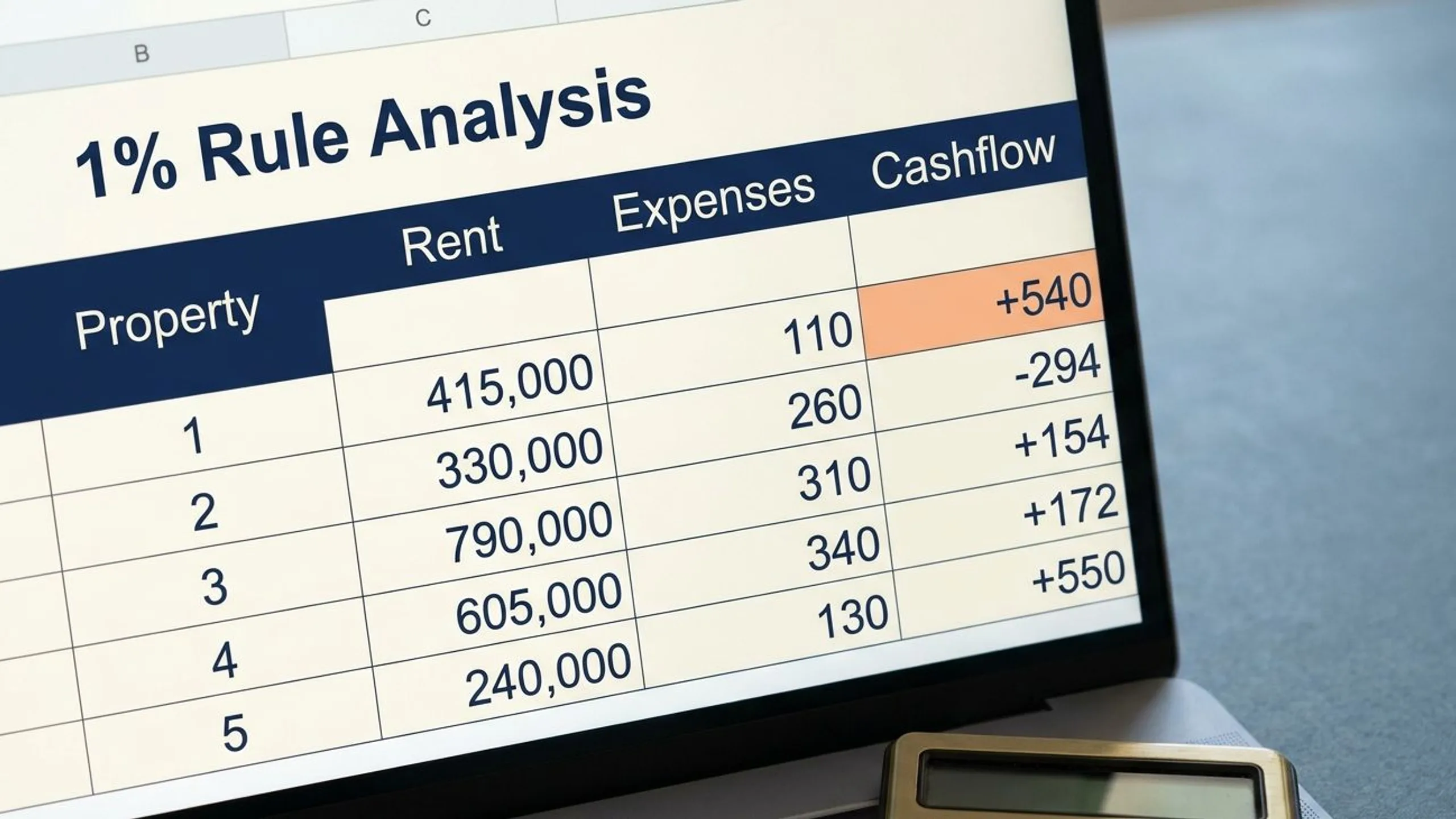
The 1% rule is the classic beginner shortcut: monthly rent should be at least 1% of the purchase price. We tested it against U.S. Census data across major cities, and the honest answer is that at median prices, the 1% rule is nearly extinct. Of the cities we checked, only Detroit still clears it, at 1.14%. Everywhere else falls short. The full ranked table is below.
This article is for beginners who keep hearing about the 1% rule and want to know if it still means anything. Every figure comes from the U.S. Census American Community Survey, 2024 estimates: median gross rent divided by median home value, city by city.
Key Takeaways
- The 1% rule: monthly rent should be at least 1% of purchase price ($1,500 rent on a $150,000 home).
- At median prices, only Detroit (1.14%) clears it in our set of major cities.
- Rust Belt cities come closest: Dayton (0.89%), Cleveland (0.88%), Toledo (0.74%).
- Expensive coastal cities are nowhere near: San Francisco (0.19%), Los Angeles and Seattle (0.21%).
- Higher mortgage rates (6.49% in July 2026 per FRED) make the rule even harder to satisfy.
- The rule is a quick screen, not a verdict. Use it to filter, then run a full analysis.
The rule in one paragraph
The 1% rule says a rental's monthly rent should be at least 1% of its price, so a $150,000 house should rent for $1,500 a month. It is a fast filter for sorting listings, not a buy signal, and it was born when homes and mortgages were cheaper. For the full explanation, a worked example, and where the rule misleads, read the 1% rule explained for beginners. This article does one job: test the rule city by city.
How we tested it
We took median home value and median gross rent for a broad set of major U.S. cities from the Census ACS 2024 estimates and calculated the monthly rent-to-price ratio for each. A ratio of 1.00% or higher means the city clears the 1% rule at the median. The full table, sorted from best to worst, is below.
Where the 1% rule still works: the full ranking
| Rank | City | Monthly rent-to-price | Median home value | Median gross rent |
|---|---|---|---|---|
| 1 | Detroit, MI | 1.14% | $95,900 | $1,091 |
| 2 | Dayton, OH | 0.89% | $117,500 | $1,042 |
| 3 | Cleveland, OH | 0.88% | $109,600 | $961 |
| 4 | Toledo, OH | 0.74% | $122,600 | $908 |
| 5 | Akron, OH | 0.68% | $142,200 | $968 |
| 6 | Birmingham, AL | 0.64% | $189,800 | $1,206 |
| 7 | Buffalo, NY | 0.61% | $187,000 | $1,142 |
| 8 | Memphis, TN | 0.6% | $209,800 | $1,263 |
| 9 | Pittsburgh, PA | 0.59% | $220,400 | $1,304 |
| 10 | Baltimore, MD | 0.54% | $247,400 | $1,345 |
| 11 | San Antonio, TX | 0.53% | $260,900 | $1,389 |
| 12 | Milwaukee, WI | 0.52% | $207,900 | $1,081 |
| 13 | Des Moines, IA | 0.52% | $213,300 | $1,107 |
| 14 | El Paso, TX | 0.51% | $209,600 | $1,066 |
| 15 | Indianapolis, IN | 0.5% | $241,500 | $1,219 |
| 16 | St. Louis, MO | 0.49% | $214,500 | $1,044 |
| 17 | Kansas City, MO | 0.49% | $261,600 | $1,292 |
| 18 | Columbus, OH | 0.49% | $279,900 | $1,383 |
| 19 | Fort Worth, TX | 0.49% | $330,500 | $1,630 |
| 20 | Fort Wayne, IN | 0.48% | $219,900 | $1,051 |
| 21 | Jacksonville, FL | 0.48% | $325,300 | $1,568 |
| 22 | Tulsa, OK | 0.47% | $234,400 | $1,099 |
| 23 | Louisville, KY | 0.47% | $241,700 | $1,144 |
| 24 | Houston, TX | 0.47% | $301,200 | $1,408 |
| 25 | Dallas, TX | 0.47% | $340,400 | $1,599 |
| 26 | Wichita, KS | 0.46% | $212,900 | $989 |
| 27 | Omaha, NE | 0.46% | $269,500 | $1,229 |
| 28 | Oklahoma City, OK | 0.45% | $259,300 | $1,178 |
| 29 | Orlando, FL | 0.43% | $430,200 | $1,841 |
| 30 | Cincinnati, OH | 0.42% | $263,300 | $1,115 |
| 31 | Tucson, AZ | 0.41% | $299,700 | $1,235 |
| 32 | Charlotte, NC | 0.4% | $431,900 | $1,720 |
| 33 | Albuquerque, NM | 0.38% | $324,600 | $1,227 |
| 34 | Nashville, TN | 0.38% | $438,800 | $1,669 |
| 35 | Phoenix, AZ | 0.38% | $454,900 | $1,712 |
| 36 | Atlanta, GA | 0.38% | $462,200 | $1,765 |
| 37 | Tampa, FL | 0.38% | $494,400 | $1,898 |
| 38 | Raleigh, NC | 0.37% | $450,300 | $1,661 |
| 39 | Las Vegas, NV | 0.37% | $458,300 | $1,688 |
| 40 | Miami, FL | 0.33% | $598,200 | $1,975 |
| 41 | Austin, TX | 0.31% | $571,000 | $1,770 |
| 42 | Denver, CO | 0.29% | $636,400 | $1,870 |
| 43 | Portland, OR | 0.28% | $588,200 | $1,648 |
| 44 | San Diego, CA | 0.25% | $980,700 | $2,414 |
| 45 | Los Angeles, CA | 0.21% | $947,900 | $1,958 |
| 46 | Seattle, WA | 0.21% | $950,800 | $2,007 |
| 47 | San Francisco, CA | 0.19% | $1,314,700 | $2,448 |
Why the rule barely works anymore
The result is striking: out of every major city we checked, only Detroit clears 1% at the median, and it barely does so at 1.14%. The next closest, Dayton and Cleveland, sit near 0.88%, and most of the country is well under 0.50%.
Two things broke the rule. First, home prices rose faster than rents over the past decade, especially in growth markets, which pushed the ratio down. Second, mortgage rates climbed. With the 30-year rate at 6.49% in July 2026 per Freddie Mac data on FRED, the same rent covers a much smaller loan than it did when rates were near 3%. A ratio that once meant positive cash flow no longer guarantees it.
The expensive coastal cities show how far the rule has drifted. San Francisco sits at 0.19%, and Los Angeles and Seattle at 0.21%. In those markets, median rent is barely a fifth of what the 1% rule would require, which is why coastal investors chase appreciation rather than cash flow.
What to use instead
The 1% rule is not useless, it is just a coarser filter than it used to be. Here is how to treat it now:
- Use it to sort, not to decide. A listing near 1% deserves a closer look. One at 0.4% probably will not cash flow without a special angle.
- Run the real numbers. After the screen, calculate actual cash flow with today's rate, real taxes, insurance, vacancy, and maintenance. A free house hacking calculator or a simple spreadsheet does this in minutes.
- Look where the ratios are highest. The affordable Midwest, where prices are low, is where the rule comes closest to working, which is no accident.
- Consider house hacking. Living in the property with an owner-occupied loan changes the math entirely, because you are offsetting your own housing cost, not trying to cover a full mortgage from rent alone.
The rule is a starting point from a cheaper era. Use it to filter fast, then let a real analysis make the call.
Frequently Asked Questions
Does the 1% rule still work in 2026?
Barely. Tested against 2024 Census data, only Detroit clears the 1% rule at the median home price, at 1.14%. Most major cities are well under 0.5%. Rising home prices and a 6.49% mortgage rate in July 2026 have made the rule very hard to satisfy, so treat it as a rough screen rather than a target.
Which cities still meet the 1% rule?
At median prices in our set of major cities, only Detroit clears the 1% rule, at 1.14%. The cities that come closest are all in the Rust Belt: Dayton (0.89%), Cleveland (0.88%), Toledo (0.74%), and Akron (0.68%). Individual below-median deals can still hit 1% even where the city median does not.
What should I use instead of the 1% rule?
Use the 1% rule only to sort listings quickly, then run a full cash-flow analysis on the ones that come close, using today's mortgage rate and real taxes, insurance, vacancy, and maintenance. Metrics like cash-on-cash return give a truer picture, and house hacking changes the math by offsetting your own housing cost.
The 1% rule is a relic of cheaper homes and lower rates, and the data shows it: at median prices, only Detroit still clears it. That is not a reason to give up on cash flow, it is a reason to screen smarter and run real numbers. Look where prices are low and ratios are highest, and consider house hacking to change the math in your favor. Start with the affordable markets in the best cities for house hacking, run your own numbers in the free house hacking calculator, and learn to analyze a deal properly in the 28-day course.
This article is education, not financial, legal, or tax advice. Real estate carries risk, and the numbers here are examples. Check them against your own market and talk to a licensed professional before you buy.