REIT vs. Rental Property: Which Is Better for First-Timers?
A REIT lets you own a slice of income-producing real estate by buying a stock. A rental property means you buy an actual building, find tenants, and collect rent yourself. Both are legitimate ways into real estate. They are not the same investment wearing different clothes, and the "which is better" framing hides the real question: which one fits your capital, your time, and your tolerance for hands-on work.
This article is for first-time investors trying to decide where to put their first real estate dollars: a REIT through a brokerage account, or a physical rental property bought with a mortgage. Neither answer is universally right. This breaks down the actual mechanics so you can pick correctly for your situation.
Key Takeaways
- REITs are liquid and passive. You can buy shares for the price of one share, no property management required, and sell in seconds during market hours.
- Rental property is illiquid and active. It takes a down payment (typically 15-25% for investment property), ongoing management, and months to sell.
- REIT dividends are taxed as ordinary income in most cases, per the SEC's investor.gov. Rental property owners get depreciation deductions that can shelter a meaningful share of cashflow from tax.
- Leverage cuts both ways. A mortgage amplifies rental property returns and losses. REITs use leverage at the company level, invisible to you as a shareholder.
- Most first-time investors underestimate the time cost of a rental property and overestimate the return ceiling of a REIT. Both mistakes are correctable once you see the real numbers side by side.
The core difference
A REIT (real estate investment trust) is a company that owns and operates income-producing property, such as apartment buildings, warehouses, or shopping centers. Per the SEC, REITs are required to distribute "at least 100 percent of their taxable income" to shareholders as dividends, which is the mechanism that makes them income-focused investments. You buy shares through a brokerage account like you would any stock or fund.
A rental property is a physical building you own directly. You (or a property manager you hire and pay) find tenants, collect rent, handle repairs, and are personally responsible for the mortgage, taxes, and insurance. Your return comes from monthly cashflow, mortgage paydown, appreciation, and tax benefits, combined.
The single biggest structural difference: a REIT is a claim on a diversified pool of properties managed by professionals. A rental property is one specific building, and you're the manager (or you hire and oversee one).
Side-by-side comparison
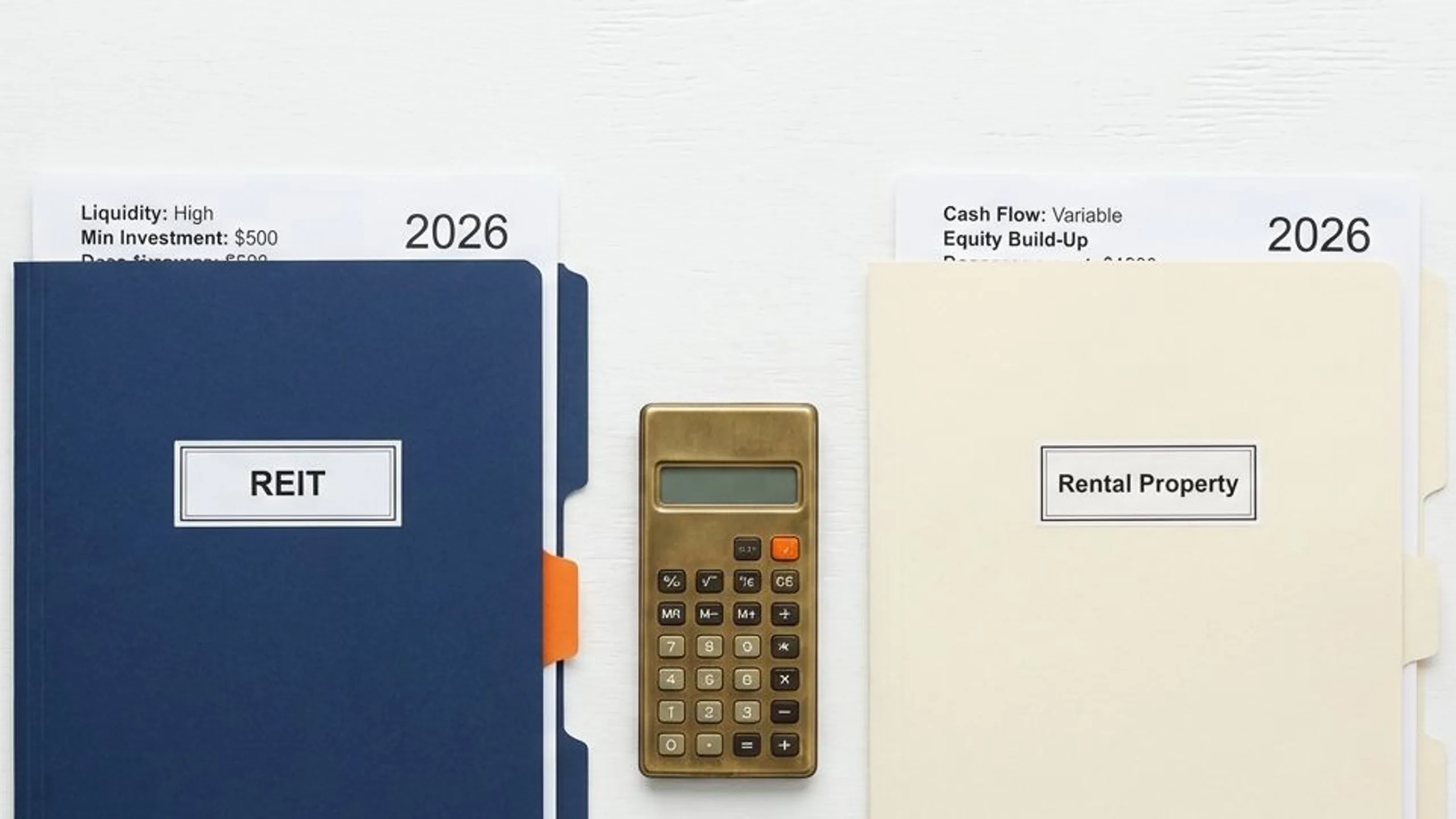
| Factor | REIT | Rental property |
|---|---|---|
| Minimum to start | Price of one share (often $10-$100) | Typically $30,000-$70,000 (down payment + closing + reserves on a $150,000-$300,000 property) |
| Liquidity | High: sell during market hours | Low: typically 30-90+ days to sell |
| Time commitment | Minutes per year | Hours per month, more during turnover or repairs |
| Leverage | Company-level, not visible to you | Direct: you personally hold the mortgage |
| Diversification | Broad, across many properties and often property types | Concentrated in one property, one market |
| Tax treatment | Dividends generally taxed as ordinary income | Depreciation and expense deductions can offset taxable cashflow |
| Control | None over property decisions | Full control over tenants, rent, repairs, financing |
| Volatility | Tracks public markets somewhat, can swing with interest rates | Tied to local property values, generally less day-to-day volatility |
A worked example: $25,000 in each
Numbers help more than adjectives. Say you have $25,000 to invest and you split it hypothetically to compare mechanics (in reality you'd likely pick one path for your first move, not both).
$25,000 into a publicly traded REIT index fund: No leverage. If the fund yields a 4% annual dividend and appreciates 3% a year, that's roughly $1,750 in combined return the first year, before taxes on the dividend portion. You did nothing operationally. You can sell any trading day if you need the cash.
$25,000 as a down payment on a $125,000 rental property (20% down, conventional investment loan): You now control a $125,000 asset with a $100,000 mortgage. If the property rents for $1,200/month and your total monthly costs (mortgage, taxes, insurance, a maintenance reserve) run $1,050, that's $150/month or $1,800/year in cashflow, roughly a 7.2% cash-on-cash return on your $25,000. Add mortgage paydown (equity building with every payment) and any appreciation, and the total return is typically higher than the REIT scenario, assuming the property performs as underwritten. It's also carrying more risk: vacancy, a bad tenant, or an unexpected repair can erase a year of cashflow, and you can't liquidate the position in an afternoon if you need the cash.
The leverage in the rental scenario is what creates the higher return potential and the higher risk. That trade-off, not one option being objectively "better," is the actual decision you're making.
Tax treatment
REIT dividends are typically taxed as ordinary income at your marginal rate, not the lower qualified-dividend rate most stock dividends get. Per IRS Topic 404, this is a structural feature of how REIT distributions are classified, not a loophole or a penalty. It simply means REIT income doesn't get the tax break that other dividend income sometimes does.
Rental property owners can depreciate the building (not the land) over 27.5 years for residential property, per IRS Publication 527, plus deduct mortgage interest, property taxes, insurance, repairs, and management costs against rental income. For many first-time landlords, depreciation alone is enough to make a cashflow-positive property show a paper loss for tax purposes, deferring tax on income you're actually receiving. This is a real advantage of direct ownership, but it comes with real recordkeeping obligations and the eventual recapture of that depreciation when you sell.
Neither structure is a tax dodge. Both are legitimate, well-documented tax treatments that shift the numbers meaningfully in different directions. If your tax situation is complex, a CPA who handles real estate should review your specific numbers before you commit either way.
When a REIT is the better first move
- You have less than $15,000-$20,000 to deploy and don't want to stretch into a thin-margin property.
- You want liquidity: money you might need within 1-3 years shouldn't be locked into an illiquid rental.
- You don't have time for tenant calls, repair coordination, or vacancy turnover, and don't want to pay a property manager to absorb that for you yet.
- You want geographic and property-type diversification without researching individual markets.
- You're testing whether real estate as an asset class fits your portfolio before committing to the operational complexity of ownership.
When a rental property is the better first move
- You have enough capital for a real down payment, closing costs, and a genuine repair reserve, not just the bare minimum.
- You're willing to spend time on tenant screening, basic maintenance decisions, and periodic turnover, or you're willing to pay a property manager and still net a decent return.
- You want direct control over the asset: which tenant you approve, when you raise rent, whether you renovate.
- You want the depreciation and expense deductions available to direct owners, and you're prepared for the recordkeeping that comes with them.
- You're building toward a specific goal, like house hacking your first home purchase or scaling to multiple properties over time, where a REIT doesn't get you there.
If direct ownership is the path you're leaning toward, how to analyze a house hack before you buy and how to finance a rental property cover the next steps in detail. The 28-day course walks through the full sequence, market selection through closing, for readers who decide direct ownership is their path.
Frequently Asked Questions
Can I own both a REIT and a rental property?
Yes, and many experienced investors do exactly that. A REIT allocation can provide liquidity and diversification while a directly owned rental property builds concentrated, leveraged equity in a specific market. There's no rule requiring you to pick one exclusively; the "which first" question in this article is about where your limited early capital and attention should go.
Are REIT returns actually lower than rental property returns?
Not necessarily, and it depends heavily on leverage and market timing. Unleveraged REIT total returns (dividends plus appreciation) have historically run in a similar range to unleveraged real estate returns over long periods. Rental property returns often look higher specifically because of mortgage leverage, which magnifies both gains and losses. Compare leveraged to leveraged or unleveraged to unleveraged, not one against the other, when you see return claims.
Is a REIT actually "real" real estate investing?
Yes. REITs own and operate physical income-producing property. You're not buying a synthetic derivative; you're buying equity in a company whose business is owning real estate. What you're not doing is controlling an individual property's decisions, which is the actual trade-off, not a question of legitimacy.
How much money do I need to start with a REIT versus a rental property?
Publicly traded REITs can be purchased for the price of a single share, often under $100, through any standard brokerage account. A rental property typically requires a down payment (15-25% for investment property, or as low as 3.5% for an owner-occupied multi-unit via FHA), closing costs, and reserves, commonly $25,000-$70,000 total for an entry-level property depending on the market.
Do REITs make sense if I eventually want to own rental property directly?
Yes, for two reasons. First, a REIT allocation can grow capital toward your eventual down payment without locking it up. Second, REIT dividends give you exposure to how income-producing real estate actually performs across market cycles while you're still learning, before you commit to a specific property and market.
What's the biggest mistake first-time investors make choosing between the two?
Underestimating the time and stress cost of direct ownership, and overestimating how "passive" a rental property will actually be in year one. The mirror-image mistake is assuming a REIT can't be a legitimate first real estate investment because it doesn't feel like "real" ownership. Both mistakes come from comparing the two options on returns alone instead of matching the choice to your actual capital, time, and risk tolerance.
Neither a REIT nor a rental property is the objectively correct first move. A REIT fits limited capital, limited time, and a preference for liquidity. A rental property fits investors with real capital, real time, and a willingness to trade liquidity for leverage and control. The free PDF guide walks through how to size up your own capital and time constraints before you commit either way.