In this article10 sections
- Why the utilities question matters more in a house hack
- The three ways to split, and the one that lasts
- Match the method to the utility
- A worked example: one duplex, one electric bill
- Take the arithmetic out of the relationship
- Put it in the lease, and check your state's rules
- Should you just include utilities in the rent?
- The 12-month audit
- Frequently Asked Questions
- The part that keeps the mortgage paid
The short answer. Split each utility by the method that matches how it is actually used: square footage for heat and electric, headcount for water and sewer, a flat share for internet and trash. Write the exact percentages into the lease before anyone moves in, show the tenant the real bill whenever they ask, and review the split once a year. Do not split everything 50/50, and do not guess month to month. A written formula is what keeps a shared meter from turning into a monthly argument.
This article is for first-time house hackers who are about to buy or have just closed on a duplex, triplex, or single-family home with roommates, and who now need to figure out who pays for what. If you are still deciding whether house hacking makes sense for you, start with house hacking for beginners and come back here once you have a property in mind.
Key Takeaways
- The financing side of a house hack gets covered everywhere. The household side, where you are both landlord and neighbor, is where most first-year friction actually happens.
- A 50/50 split is almost never fair in a duplex. Units differ in size, occupancy, and equipment, and the split should reflect that.
- Match the method to the utility: square footage for gas and electric, headcount for water and sewer, equal shares for internet and trash.
- Several states regulate shared-meter billing. Minnesota, Arizona, and California all require written disclosure of the method, and Minnesota caps the admin fee at $8 per billing period.
- Put the percentages in the lease, keep a simple ledger, and audit the split every 12 months.
Why the utilities question matters more in a house hack
In a normal rental, utilities are a line item. In a house hack, they are a relationship.
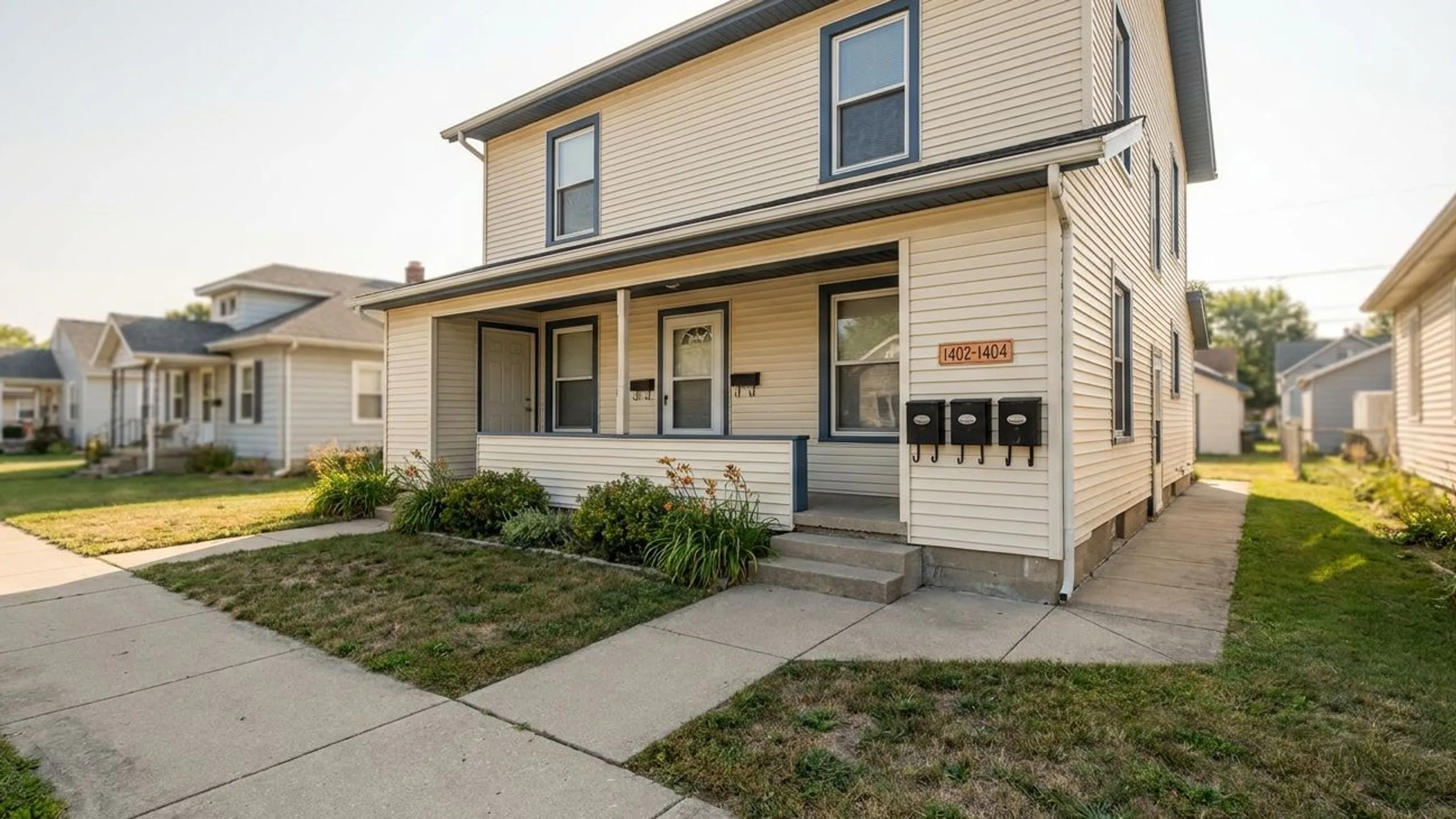
You live in one unit. Your tenant lives in the other, often behind a shared wall, sometimes sharing a basement, a yard, a driveway, and a WiFi router. Many older duplexes have one electric meter and one gas meter for the whole building. That means your thermostat habits and your tenant's space heater land on the same bill, and someone has to decide how to divide it.
The financing that makes house hacking work, an FHA loan at 3.5% down or a VA loan at 0% down for an owner-occupied property with up to four units, is the part everyone explains. What rarely gets explained is that the same owner-occupancy that unlocks the loan also puts you in the same building as the person paying most of your mortgage. The way you handle shared costs sets the tone for the whole arrangement, and a tenant who feels nickel-and-dimed does not renew.
Turnover is the real cost here. A vacancy between tenants, plus cleaning, relisting, and screening, can erase several months of cash flow on a small multifamily. A transparent, predictable utility split is one of the cheapest retention tools you have.
The three ways to split, and the one that lasts
There are three common approaches. Only one of them holds up past the first year.
Equal split. Total bill divided by the number of units or people. Simple, and almost always wrong for a duplex. If you occupy a 1,200 square foot upper unit and your tenant has an 800 square foot lower unit, an equal electric split means the tenant subsidizes 40% more living space than they have.
Headcount split. Divide by the number of occupants. Better for water and sewer, where usage tracks people more than floor area. Worse for heat and electric, and it creates a new argument the day your tenant's partner starts staying over four nights a week.
Predetermined formula, written into the lease. You pick a method for each utility before move-in, set the percentages, and revisit them once a year. The percentages do not need to be equal. They need to be defensible, and the tenant needs to be able to check them against the actual bill.
The third approach is the only one that removes mental math from the relationship. It is also the approach several state laws now require.
Match the method to the utility
Different utilities are driven by different things, so use a different basis for each.
| Utility | Best basis | Why |
|---|---|---|
| Electric | Square footage (or separate meters) | Lighting, appliances, and cooling scale with space |
| Gas / heating | Square footage | Heat load is driven by floor area and exposure |
| Water / sewer | Headcount | Showers, laundry, and dishes track people, not rooms |
| Trash | Equal per unit | Flat municipal fee, same service for everyone |
| Internet | Equal per unit, or bundle into rent | Same connection, same speed |
| Lawn, snow, common-area lighting | Owner pays | Treat it as an operating expense, not a shared bill |
Minnesota's shared-meter statute takes the same view. Under Minnesota Statutes 504B.216, a landlord who apportions natural gas must do it by each unit's square footage as a share of all units, and water and sewer must be apportioned by the number of tenants on the lease as a share of the building's occupancy. You do not have to live in Minnesota for that to be a sensible default.
A worked example: one duplex, one electric bill
Here is the math on a real-looking duplex, so you can see how much the method changes the outcome.
- Building: 2,000 square feet. You live upstairs in 1,200 square feet with a partner. Your tenant lives downstairs in 800 square feet alone.
- One electric meter. The bill this month is $230.
- For reference, the U.S. Energy Information Administration reports the average residential electric bill was $144 per month in 2024, at 865 kilowatt-hours per customer and 16.5 cents per kilowatt-hour. A two-unit building running $230 is unremarkable.
Three ways to split that $230:
| Method | Tenant pays | You pay |
|---|---|---|
| Equal (50/50) | $115 | $115 |
| Headcount (1 of 3 people) | $77 | $153 |
| Square footage (800 of 2,000) | $92 | $138 |
The tenant's share swings from $77 to $115 depending on a decision you made in thirty seconds. Over a 12-month lease that is a $456 difference. Pick square footage for electric, write "Tenant pays 40% of the building electric bill, calculated from 800 of 2,000 square feet" into the lease, and the conversation is over before it starts.
For water on the same building, headcount is the better basis: the tenant pays one-third of the water and sewer bill. For the $80 internet plan, either split it $40 each or fold $40 into the rent and provide WiFi as an amenity.
If you want to model how each split changes your monthly numbers before you set it, run the scenarios in the house hacking calculator. The utilities line is usually the second-largest expense you control after the mortgage.
Take the arithmetic out of the relationship
Even with a clean formula, someone still has to do the monthly math, track who paid the water bill, and net it all out. That is where resentment creeps in: not from the percentages, but from the 9pm text that says "you owe me $38 for last month."
Two ways to remove that friction:
- Bill back on a fixed schedule. Once a month, you forward the actual utility bill with the tenant's share calculated and the formula shown. Same day every month. The tenant pays it with rent or within 10 days, whichever the lease says.
- Use a calculator that handles uneven splits and who-paid-what. For shared-household costs that do not divide evenly, a tool like Household Saga's fair expense split calculator handles equal, percentage, share-based, income-ratio, custom, and itemized splits, then reduces everything to the minimum set of transfers. That matters when you paid the electric bill and the tenant bought the furnace filters: you want one number, not a ledger.
Either way, the goal is the same. The tenant should be able to see the real bill, see the percentage, and reproduce your number in under a minute.
Put it in the lease, and check your state's rules
The split is only as good as the paper it is written on. Your lease should state, for each utility: who the account holder is, the allocation basis, the exact percentage, when the tenant will be billed, and when payment is due. If you charge any administrative fee for the billing work, state the amount.
Several states have turned those best practices into law, and more are following:
- Arizona. A.R.S. 33-1314.01 requires the rental agreement to list which utilities are billed separately and disclose any administrative fee, limits that fee to actual administrative cost, and requires each bill to show the charges for the period and the meter readings. Switching an existing tenant to allocated billing requires at least 90 days' notice.
- Minnesota. Under 504B.216, the landlord must provide a copy of the actual utility bill on request, cannot charge the tenant for submeter installation or repair, and is capped at an $8 administrative charge per billing period and a $5 monthly late fee.
- California. Civil Code 1940.9 requires the landlord to disclose, before the tenancy starts, when a tenant's meter also serves another unit or a common area, and to either put the arrangement in a written agreement or become the customer of record for that meter. A tenant can sue for reimbursement if that disclosure was never made.
If your state has no specific statute, the Arizona and Minnesota rules are still a good template: disclose the method in writing, show the real bill, keep any fee small, and give notice before changing anything. Check your state's landlord-tenant statute and your city's rental ordinance before you sign the first lease, and add this to your new landlord first-day checklist so it does not get lost in the closing chaos.
Should you just include utilities in the rent?
Sometimes, yes. For rooms in a single-family house hack, most owners bundle utilities into the rent because a per-person split across three or four roommates generates more arguments than it saves. If that is your setup, price the room with utilities included and put the house rules on shared spaces in writing.
For a duplex or triplex with its own kitchens and thermostats (the trade-offs are covered in single-family vs duplex house hacking), bundling is riskier. You are absorbing the tenant's usage with no feedback loop, and a tenant who runs the AC at 66 degrees all July is costing you real money, the kind of line item that shows up in the hidden costs of owning a rental. If you bundle, set the rent with a realistic utility allowance (the last 12 months of bills divided by 12, times the tenant's share, rounded up) and put a usage cap in the lease so you can bill back the excess.
The cleanest long-term fix is separate meters. Installing a second electric meter on a duplex typically runs a few hundred to a few thousand dollars depending on the panel and the utility's requirements, and the number is estimated here because it varies widely by market. If you plan to hold the property after you move out, separate meters pay for themselves in saved billing work and fewer disputes, and they make the building easier to sell.
The 12-month audit
Shared costs drift. Utility rates change. The tenant who moved in alone gets a roommate. Your own household changes. The split that was fair at move-in is often off by the second winter.
Once a year, ideally at lease renewal, pull the last 12 months of shared bills and compare the actual totals against what each side paid. If the gap is material, adjust the percentage and document the change as a lease addendum. If it is not, leave it alone. The goal is not to optimize every dollar. It is to prevent the slow drift where one party quietly subsidizes the other until it becomes a reason to leave.
This is the same habit that separates the owners who keep tenants for three or four years from the ones who relist every spring, and it belongs on the same list as the other first-time landlord mistakes worth avoiding in year one.
Frequently Asked Questions
Is it legal to split utilities between tenants on one meter?
In most states, yes, as long as the lease discloses the arrangement and the method. Some states regulate it directly: Arizona, Minnesota, and California all require written disclosure of the allocation basis, and some cap administrative fees. Check your state's landlord-tenant statute, because a few cities go further and prohibit allocated billing for certain utilities.
How do you split utilities in a duplex fairly?
Use square footage for electric and gas, headcount for water and sewer, and an equal per-unit share for internet and trash. Write the exact percentages into the lease and share the actual bill with the tenant each month. A 50/50 split is only fair when the two units are genuinely similar in size and occupancy.
Can I charge my tenant a fee for handling the utility billing?
Only if the lease discloses it, and in regulated states only up to a cap. Minnesota limits the charge to $8 per billing period. Arizona limits it to your actual administrative cost. Where there is no statute, keep it small or skip it. A fee that looks like profit on a pass-through bill is a fast way to lose a good tenant.
What if my tenant uses far more electricity than their share?
That is the main argument for separate meters or a submeter on the heaviest-use circuit. Short of that, the lease can include a usage cap with a bill-back for overages, or you can switch that utility to a headcount or itemized basis at renewal. Change the method only with written notice, and in Arizona that notice must be at least 90 days.
Should house hackers include utilities in the rent instead?
For rent-by-the-room setups, usually yes, because per-person splits among roommates create constant friction. For duplexes and triplexes, bundling means you absorb the tenant's usage with no feedback loop. If you bundle, price the rent with a 12-month utility allowance and include a usage cap in the lease.
The part that keeps the mortgage paid
House hacking is not only about the loan product. The loan gets you into the building. What keeps you there, and keeps the rent covering the mortgage, is running a small shared property in a way that makes a good tenant want to renew.
A documented utility split that the tenant can verify against the real bill is the simplest version of that. Pick the basis per utility, put the percentages in the lease, show the bill, and check the numbers once a year. It takes one afternoon to set up and removes a year of 9pm texts.
This article is education, not financial, legal, or tax advice. Real estate carries risk, and the numbers here are examples. Check them against your own market and talk to a licensed professional before you buy.